The operation of the Contagious Diseases Acts among the troops in the United Kingdom, and men of the Royal Navy on the home station : from their introduction in 1864 to their ultimate repeal in 1884 / by Robert Lawson.
- Lawson, Robert
- Date:
- 1891
Licence: Public Domain Mark
Credit: The operation of the Contagious Diseases Acts among the troops in the United Kingdom, and men of the Royal Navy on the home station : from their introduction in 1864 to their ultimate repeal in 1884 / by Robert Lawson. Source: Wellcome Collection.
Provider: This material has been provided by The Royal College of Surgeons of England. The original may be consulted at The Royal College of Surgeons of England.
3/44
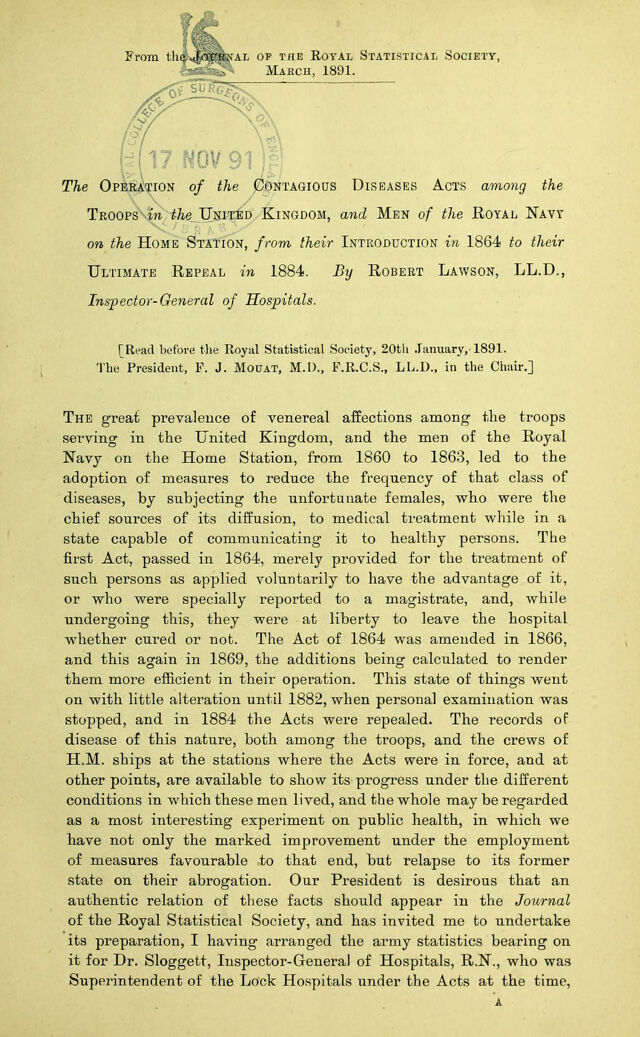
![From tli' al or the Royal Statistical Society, March, 1891. The Operation of the Contagious Diseases Acts among the Troops in the Untted Kingdom, and Men of the Royal Navy on the Home Station, from their Introduction in 1864 to their Ultimate Repeal in 1884. By Robert Lawson, LL.D., Inspector-General of Hospitals. [Read before the Royal Statistical Society, 20th January,'1891. The President, F. J. Mouat, M.D., F.R.C.S., LL.D., in the Chair.] The great prevalence of venereal affections among the troops serving in the United Kingdom, and the men of the Royal Navy on the Home Station, from 1860 to 1863, led to the adoption of measures to reduce the frequency of that class of diseases, by subjecting the unfortunate females, who were the chief sources of its diffusion, to medical treatment while in a state capable of communicating it to healthy persons. The first Act, passed in 1864, merely provided for the treatment of such persons as applied voluntarily to have the advantage of it, or who were specially reported to a magistrate, and, while undergoing this, they were at liberty to leave the hospital whether cured or not. The Act of 1864 was amended in 1866, and this again in 1869, the additions being calculated to render them more efficient in their operation. This state of things went on with little alteration until 1882, when personal examination was stopped, and in 1884 the Acts were repealed. The records of disease of this nature, both among the troops, and the crews of H.M. ships at the stations where the Acts were in force, and at other points, are available to show its progress under the different conditions in which these men lived, and the whole may be regarded as a most interesting experiment on public health, in which we have not only the marked improvement under the employment of measures favourable to that end, but relapse to its former state on their abrogation. Our President is desirous that an authentic relation of these facts should appear in the Journal of the Royal Statistical Society, and has invited me to undertake its preparation, I having arranged the army statistics bearing on it for Dr. Sloggett, Inspector-General of Hospitals, R.N., who was Superintendent of the Lock Hospitals under the Acts at the time, A](https://iiif.wellcomecollection.org/image/b22305178_0005.jp2/full/800%2C/0/default.jpg)