The operation of the Contagious Diseases Acts among the troops in the United Kingdom, and men of the Royal Navy on the home station : from their introduction in 1864 to their ultimate repeal in 1884 / by Robert Lawson.
- Lawson, Robert
- Date:
- 1891
Licence: Public Domain Mark
Credit: The operation of the Contagious Diseases Acts among the troops in the United Kingdom, and men of the Royal Navy on the home station : from their introduction in 1864 to their ultimate repeal in 1884 / by Robert Lawson. Source: Wellcome Collection.
Provider: This material has been provided by The Royal College of Surgeons of England. The original may be consulted at The Royal College of Surgeons of England.
42/44 page 38
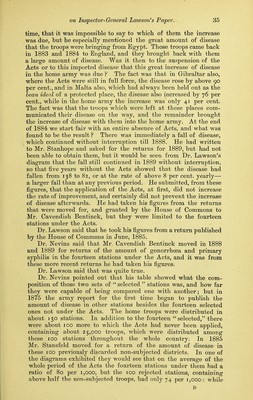
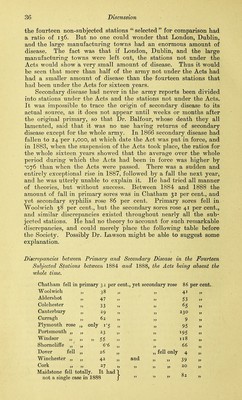
![During the last five or six years he had noticed a great increase in the severer forms of the disease, particularly amongst the women. Indurated sores are now much more frequently met with than formerly. One effect of the removal of the Contagious Diseases Acts is that the hospital authorities have now no power to keep the women in hospital until they are fit to he discharged. Women often come into the hospital, get partially relieved of the more painful symptoms, and then, regardless of the fact of their being in a highly infectious condition, insist upon going out; sometimes a hatch of women, all of whom are more or less diseased, will agree to leave the hospital simultaneously, and however diseased they may he, they cannot be prevented. The effect of this is seen in the general increase of the disease throughout the country. Sir Rawson W. Rawson thought it right to mention his experience of the operation of the Acts in Barbados. In 1869 or 1870 the Acts were brought into operation there, to the very great benefit of the community, the military, and the women themselves. It was his duty to keep a close watch upon the operation of the Acts, and occasionally to visit the hospitals, and he certainly thought it right to bear his testimony to the advantageous opera- tion of the Acts there from 1870 to 1875. Mr. J. B. Martin said he must apologise for intruding in the discussion, as this was a subject on which he had no knowledge or authority whatever, but as a statistician he wished to make one remark on the tables submitted to them. They could see the fall to which Dr. Kevins had called attention, from 148 to 67, during the six years when Lord Herbert’s recommendations were in force; that was at an average of 6’7 per cent, per annum. During the next cycle there was the continued operation of Lord Herbert’s recommendations, assisted by the operation of the Contagious Diseases Acts, and Dr. Kevins had pointed out that the fall was 6-3 as against 6] ; that was a very small difference. It seemed to him that in such a case one might reasonably expect that the fall would be more and more difficult to maintain in its ratio, that, except by the introduction of some new force, the fall would tend to diminish year by year. A third cycle was indicated by the violet line, when the motive of concealment came into play. From that point there was a rise to the period when the Act was abolished. The result of the observations to be deduced from these tables seemed to him to be that it was a great advan- tage that they had opposite views stated from a purely statis- tical standpoint, so as to enable the meeting to sift accurately the facts and phenomena which were brought under its obser- vation. Dr. Lawson said it had been his lot to hear a great deal of the evidence on both sides of the question, and almost every word of Dr. Kevins’s statements had come before him previously; on most occasions he had, he believed, refuted them, at all events to his belief satisfactorily, though apparently not so to Dr. Kevins.](https://iiif.wellcomecollection.org/image/b22305178_0044.jp2/full/800%2C/0/default.jpg)