Licence: Public Domain Mark
Credit: Training in theory and practice / by Archibald Maclaren. Source: Wellcome Collection.
Provider: This material has been provided by the Royal College of Physicians of Edinburgh. The original may be consulted at the Royal College of Physicians of Edinburgh.
183/228 (page 165)
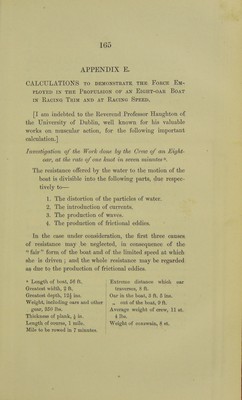
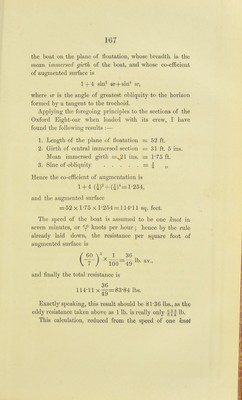
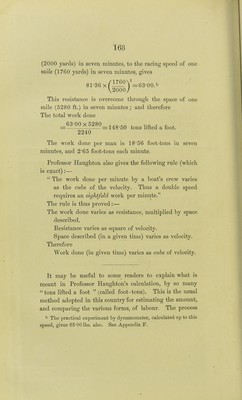
![APPENDIX E. CALCULATIONS to demonstrate the Force Em- ployed in the Propulsion of an Eight-oar Boat in Racing Trim and at Racing Speed. [I am indebted to the Reverend Professor Haughton of the University of Dublin, well known for his valuable works on muscular action, for the following important calculation.] Investigation of the Work done by the Grew of an Eight- oar, at the rate of one knot in seven minutes a. The resistance offered by the water to the motion of the boat is divisible into the following parts, due respec- tively to— 1. The distortion of the particles of water. 2. The introduction of currents. 3. The production of waves. 4. The production of frictional eddies. In the case under consideration, the first three causes of resistance may be neglected, in consequence of the fair form of the boat and of the limited speed at which she is driven ; and the whole resistance may be regarded as due to the production of frictional eddies. a Length of boat, 56 ft. Greatest width, 2 ft. Greatest depth, 12£ ins. Weight, including oars and other gear, 350 lbs. Thickness of plank, £ in. Length of course, 1 mile. Mile to be rowed in 7 minutes. Extreme distance which oar traverses, 8 ft. Oar in the boat, 3 ft. 5 ins. „ out of the boat, 9 ft. Average weight of crew, 11 st. 4 lbs. Weight of coxswain, 8 st.](https://iiif.wellcomecollection.org/image/b2198346x_0183.jp2/full/800%2C/0/default.jpg)