A new classification of human tooth forms with special reference to a new system of artificial teeth / by J. Leon Williams.
- Williams, John Leon.
- Date:
- [1914], ©1914
Licence: Public Domain Mark
Credit: A new classification of human tooth forms with special reference to a new system of artificial teeth / by J. Leon Williams. Source: Wellcome Collection.
Provider: This material has been provided by the Augustus C. Long Health Sciences Library at Columbia University and Columbia University Libraries/Information Services, through the Medical Heritage Library. The original may be consulted at the the Augustus C. Long Health Sciences Library at Columbia University and Columbia University.
33/124 (page 17)
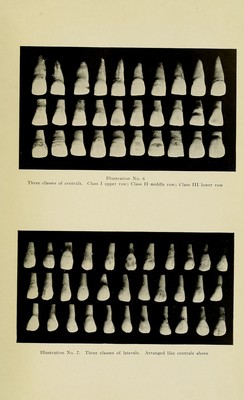
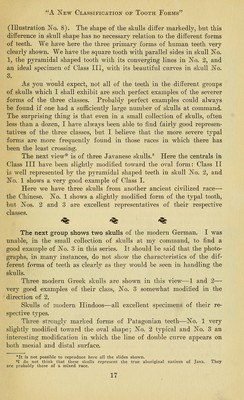
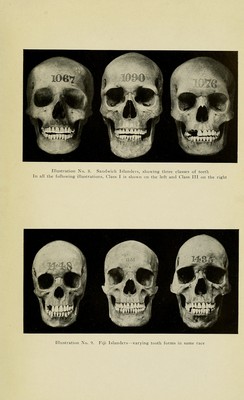
![(Ulustration ISTo. 8). The shape of the skulls differ markedly, but this difference in skull shape has no necessary relation to the different forms of teeth. We have here the three primary forms of human teeth very clearly shown. We have the square tooth with parallel sides in skull ]^o. 1, the pyramidal shaped tooth with its converging lines in JSTo. 2, and an ideal specimen of Class III, with its beautiful curves in skull No. 3. As you would expect, not all of the teeth in the different groups of skulls which I shall exhibit are such perfect examples of the severer forms of the three classes. Probably perfect examples could always be found if one had a sufficiently large number of skulls at command. The surprising thing is that even in a small collection of skulls, often less than a dozen, I have always been able to find fairly good represen- tatives of the three classes, but I believe that the more severe typal forms are more frequently found in those races in which there has been the least crossing. The next view* is of three Javanese skulls.^ Here the centrals in Class III have been slightly modified toward the oval form: Class II is well represented by the pyramidal shaped teeth in skull ISTo. 2, and 'No. 1 shows a very good example of Class I. Here we have three skulls from another ancient civilized race— the Chinese. No. 1 shows a slightly modified form of the typal tooth, but ISTos. 2 and 3 are excellent representatives of their respective classes. «<fe *% -^ The next group shows two skulls of the modern German. I was unable, in the small collection of skulls at my command, to find a good example of No. 3 in this series. It should be said that the photo- graphs, in many instances, do not show the characteristics of the dif- ferent forms of teeth as clearly as they would be seen in handling the skulls. Three modern Greek skulls are shown in this view—1 and 2— very good examples of their class, ]^o. 3 somewhat modified in the direction of 2, Skulls of modern Hindoos—all excellent specimens of their re- spective types. Three strongly marked forms of Patagonian teeth—l^o. 1 very slightly modified toward the oval shape; ITo. 2 typical and ISTo. 3 an interesting modification in which the line of double curve appears on both mesial and distal surface. *It is not possible to reproduce here all the slides shown. ^I do not think that these skulls represent the true aboriginal natives of Java. They are probably those of a mixed race.](https://iiif.wellcomecollection.org/image/b21204019_0033.jp2/full/800%2C/0/default.jpg)