A new classification of human tooth forms with special reference to a new system of artificial teeth / by J. Leon Williams.
- Williams, John Leon.
- Date:
- [1914], ©1914
Licence: Public Domain Mark
Credit: A new classification of human tooth forms with special reference to a new system of artificial teeth / by J. Leon Williams. Source: Wellcome Collection.
Provider: This material has been provided by the Augustus C. Long Health Sciences Library at Columbia University and Columbia University Libraries/Information Services, through the Medical Heritage Library. The original may be consulted at the the Augustus C. Long Health Sciences Library at Columbia University and Columbia University.
73/124 (page 45)
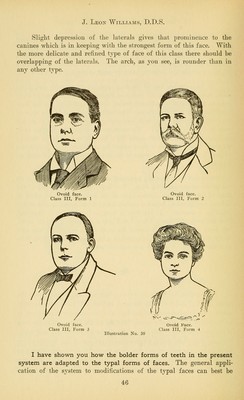
![For tlie shorter tapering female faces in this class forms have been designed, and also for the medium and longer tapering faces. In all of these types, particularly those with the sharper form of face, with a somewhat pointed arch, there is often more or less overlapping of both centrals and laterals, but especially centrals. On page 44 are two of the long tapering faces which are, I be- lieve, much more frequently found in England and some parts of Italy than in Germany or the United States, although many of the old iSTew England stock had long faces. The teeth best suited to this type of face will be rather long, with converging proximal lines such as are seen in forms of Class XL We sometimes find in faces of this type, in England, a rather short upper lip. In such cases, and, in fact, in all cases where we find a short upper lip combined with prominence of jaw, I think it better always to use short teeth or those of medium length. But teeth with tapering proximal sides should be selected for all variations of the tapering face. The duplication and reversal of the lines of the face in the shorter lines of the teeth produces an effect of balance and harmony which a trained artist would perceive and under- stand in a moment. If the face is long and only slightly tapering, then the teeth of Form 1, Class I wiU give a good effect. In all taper- ing faces with rather full cheeks the teeth in Class III are also per- fectly suitable. Harmony is produced with these teeth, as with those of Class II, by contrast or reversal of line. <% 'fgf -^ Illustration ]^o. 30 is the type of face to which I have given the name ovoid, and for which the teeth in Class III have been specially made. The greatest width of the face, as I have already pointed out, is in the region of the malar bones. But the entire lower part of the face is heavier than in any other type. The cheeks are full, round, and thick. Women with these facial characteristics are sometimes spoken of as belonging to the voluptuous type. The beautifully curved outlines and generally rounded character of the teeth in Class III will give the most harmonious and satisfactory effects in faces of this t}^e.](https://iiif.wellcomecollection.org/image/b21204019_0073.jp2/full/800%2C/0/default.jpg)