The immune system: genes, receptors, signals : [proceedings] / edited by Eli E. Sercarz, Alan R. Williamson [and] C. Fred Fox.
- ICN-UCLA Symposium on Molecular Biology
- Date:
- 1974
Licence: Attribution-NonCommercial 4.0 International (CC BY-NC 4.0)
Credit: The immune system: genes, receptors, signals : [proceedings] / edited by Eli E. Sercarz, Alan R. Williamson [and] C. Fred Fox. Source: Wellcome Collection.
655/664 page 627
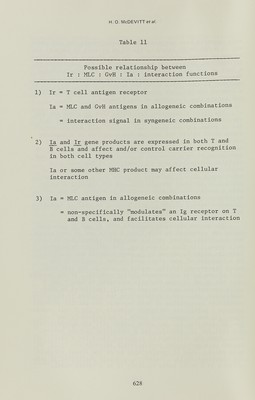
![THE IMMUNE SYSTEM on y recently been appreciated and experiments are now under way in a number of laboratories In an attempt to unravel the nature of these relationships. In the absence of definitive information, perhaps the best approach is the generation of a list of the most likely alternative in the relationships between these functions so that further experiments can be designed to test these alternate possibilities. Table 11 is a list of the possible relationships between Ir:MLC:GvH:la : and interaction functions of the I region. The first alternative postulates that genes are the structural genes for the T cell antigen receptor, and that the la genes are the genes that control cell surface struc¬ tures which elicit the MLC and GvH reactions in allogeneic combinations and which are responsible for effective T-B cellular cooperation in syngeneic combinations. Thus Ir is postulated to be a separate function while la, MLC, GvH and cellular interaction are all functions of the same gene products. The major objection to this alternative is the experiments already referred to above which indicate genetic control of antibody specificity, and the limiting dilution cell transfer studies also referred to above. In any event, acceptance of this alternative would require isolation and characterization of the I^ gene product as well as isolation and characterization of the la antigens. The second alternate suggests that I^ and gene pro¬ ducts are expressed in both T and В cells and in some manner, not specified, affect carrier antigenic recognition in both cell types. In this alternative, the cellular interaction function might be served by gene products but could also be a function of some other gene in the region of the major histocompatibility complex or even in the left hand half of the major histocompatibility complex. If one assumes that the ^a or I^ gene products expressed in both T and В cells are antigen specific and totally restricted in their expression, this model suffers from the problem of requiring coordinate recognition of both haptenic and carrier determin¬ ants on a particular antigenic molecule by the В cell popula¬ tion. If one assumes that there is approximately one cell per lO'* specific for any given hapten [47] and approximately one cell per lO'^ specific for a particular carrier determi¬ nant, then the incidence of precursor cells for a particular hapten on a particular carrier would approach one in 10 or more cells. This is considerably below the lowest estimate for precursor cells. Therefore, clonally restricted I^ gene effects in В cells seems unlikely to be a viable model. 627](https://iiif.wellcomecollection.org/image/b18036387_0656.JP2/full/800%2C/0/default.jpg)



 No text description is available for this image
 No text description is available for this image
 No text description is available for this image