Variations in the occurence of salicin and salinigrin in different willow and poplar barks / by H.A.D. Jowett and C.E. Potter.
- Jowett, H. A. D. (Hooper Albert Dickinson)
- Date:
- [1902]
Licence: In copyright
Credit: Variations in the occurence of salicin and salinigrin in different willow and poplar barks / by H.A.D. Jowett and C.E. Potter. Source: Wellcome Collection.
10/16 page 8
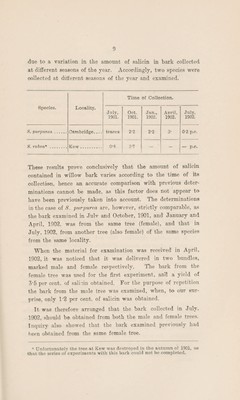
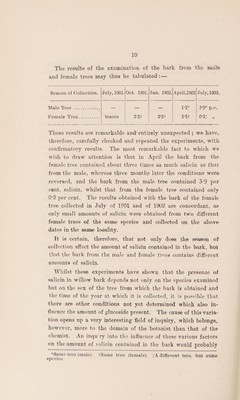
![In those cases in which salicin and salinigrin were isolated their identity was established by the determination of the following constants :— Salicin, melted at 200° corr., gave a red colour with sul¬ phuric acid, and in aqueous solution [a]D = — 64-40. Beilstein gives melting'point, 201° and [<x]d = —65°. Salinigrin, melted at 193° corr., gave no colour with sul¬ phuric acid, in aqueous solution [a]D = —85°, and gave crystal¬ line metahydroxybenzaldehyde on hydrolysis. Previously found for salinigrin (J.C.S., loc. cit.), melting point 195° corr., and [a] d = —87-3°. For the purpose of comparison it seems desirable to give here a list of the species of Salix and Popidus which have been stated by previous investigators to contain salicin and those in which salicin has not been detected. (cf. ‘ Die Glykoside,’ loc. cit.) Salicin has beeu found in Salix helix, *S. purpurea, *S. alba, S. Lambertina, S. incana, S. amygclalina, S. fissa, S. hastala, S.prcecox, * S. pentandra, S. polyandra, * S. fragilis, *S. Rus- seliana, Populus tremula, *P. alba, P. grceca, and *P. balsa- mi f era. The following species have been examined and did not yield salicin :—*S. vitellina, S. caprea, *S. viminalis, S. daphnoides, *S. babylonica, S. bicolor, *S. triandra, S. argentea, *P. nigra, *P. monilifera, P. fastigiata, P. balsamea, P. virginica, P. angu- losa, and P. grandiculata. It will thus be seen that salinigrin has been found in only one species—viz., S. discolor, and that it is not present in the two samples of S. nigra examined. Furthermore, out of thirty-three specimens examined, there were only eight which gave positive evidence of the existence of salicin or an analogous glucoside, and only in two instances were the glucosides present in sufficient quantity to be separated and identified. As the results obtained were not in harmony with those of previous observers, it was thought that perhaps this might be * These species were examined in the present investigation.](https://iiif.wellcomecollection.org/image/b30602683_0010.jp2/full/800%2C/0/default.jpg)