Annual report of the Department of Public Health / Union of South Africa.
- South Africa. Department of Health
- Date:
- [1945]
Licence: Public Domain Mark
Credit: Annual report of the Department of Public Health / Union of South Africa. Source: Wellcome Collection.
6/72 (page 4)
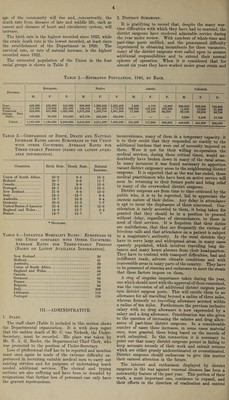
![age of the community will rise and, .concurrently, the death rate from diseases of late and middle life, such as cancer and diseases of heart and circulatory system, will increase. The birth rate is the highest recorded since 1923, while the crude death rate is the lowest recorded, at least since the establishment of the Department in 1920. The survival rate, or rate of natural increase, is the highest recorded since 1922. The estimated population of the Union in the four racial groups is shown in Table 2. 2. District Surgeons. It is gratifying to record that, despite the many war¬ time difficulties with which they have had to contend, the district surgeons have rendered admirable service during the year under review. With numbers of whole-time and part-time posts unfilled, and the pronounced difficulty experienced in obtaining incumbents for these vacancies, many of the district surgeons were called upon to assume additional responsibilities and to extend their normal spheres of operation. When it is considered that for almost six years they have worked under great strain and Table 2.—Estimated Population, 1944, by Race. Province. European. Native. / Asiatic. Coloured. M. F. P. M. F. P. M. F. P. M. F. P. Cape. Natal. Transvaal.... Orange Free State. Union ..-. 423,000 115,000 524,000 100,000 422,000 116,000 501,000 99,000 845,000 231,000 1,025,000 199,000 998,900 846,500 1,672,200 301,700 1,266,500 931,800 1,289,700 323,200 2,265,400 1,778,300 2,961,900 624,900 7,600 106,000 17,800 4,700 100,400 12,700 12,300 206,400 30,500 396,600 11,000 30,100 9,200 393,000 10,800 29,600 8,500 789,600 21,800 59.700 17.700 1,162,000 1,138,000 2,300,000 3,819,300 3,811,200 7,630,500 131,400 117,800 249,200 446,900 441,900 888,800 Table 3.—Comparison op Birth, Death and Natural Increase Rates among Europeans in the Union WITH OTHER COUNTRIES. AVERAGE RATES FOR Three-yearly Periods (based on latest avail¬ able information). Countries. Birth Rate. Death Rate. Natural Increase. Union of South Africa. 25-9 9-4 16-5 Holland. 20-7 9-0 11-7 Canada. 22-4 9-8 12-6 Portugal. 26-1 15-6 10-5 New Zealand. 21-9 9-9 12-0 Italy. 23-5 13-7 9-8 Australia. 19-7 10-3 9-4 Germany. 20-0 12-3 7-7 United States of America 23-4 10-8 12-6 England and Wales ... 14-9 12-7 2-2 France. 14-7 15-7 * * Decrease. Table 4.—Infantile Mortality Rates : Europeans in the Union compared with Other Countries. Average Rates for Three-yearly Periods (Based on Latest Available Information). New Zealand. 30 Holland. 41 Australia. 39 Union of South Africa. 45 England and Wales. 54 Canada. 57 Germany. 64 France. 78 Belgium. 84 Italy. 109 Lithuania. 118 Portugal. 128 III. -ADMINISTRATIVE. 1. Staff. The staff chart (Table 5) included in this section shows the Departmental organisation. It is with deep regret that the sudden death of Mr. C. van Niekerk, the Under¬ secretary, must be recorded. His place was taken by Mr. N. A. G. Reeler, the Departmental Chief Clerk, who was promoted to the position of Under-Secretary. Loss of professional staff has to be reported and mention must once again be made of the extreme difficulty ex¬ perienced in recruiting suitable medical men to carry out existing services and for purposes of undertaking much needed additional services. The clerical and typing sections are also suffering and have been so denuded by resignations that further loss of personnel can only have the gravest repercussions. inconvenience, many of them in a temporary capacity, it is to their credit that they responded so readily to the additional burdens that were out of necessity imposed on them. Were it not for their willing co-operation the medical services, during these critical times, would un¬ doubtedly have broken down in many of the rural areas. In many instances it was found necessary to apportion vacant district surgeoncy areas to the neighbouring district surgeons. It is expected that as the war has ended, those medical practitioners who have been on active service will soon be returning to their former posts and bring relief to many of the overworked district surgeons. District surgeons are from time to time criticised by the public who, it is to be regretted, fail to appreciate the onerous nature of their duties. Any delay in attendance is apt to incur the displeasure of those concerned. Con¬ sideration is rarely accorded to them, it being taken for granted that they should be in a position to proceed without delay, regardless of circumstances, to those in need of their services. It is forgotten that their duties are multifarious, that they are frequently the victims of frivolous calls and that attendance on a patient is subject to a magistrate’s authority. In the rural districts they have to serve large and widespread areas, in many cases sparsely populated, which involves travelling long dis¬ tances and many hours absence from their headquarters. They have to contend with transport difficulties, bad and indifferent roads, adverse climatic conditions and with inaccessible areas in many parts of the country. They have to be possessed of stamina and endurence to meet the strain that these factors impose on them. A step of singular importance taken during the year, one which should meet with the approval of those concerned] was the conversion of all additional district surgeon posts into district surgeon posts. This will entitle them to an allowance for all travelling beyond a radius of three miles, whereas formerly no travelling allowance accrued within a radius of ten miles. Furthermore the previous inclusive salary with no drug allowance is now superseded by a salary and a drug allowance. Consideration was also given to the question of increasing the salaries and drug allow¬ ances of part-time district surgeons. In a considerable number of cases these increases, in some cases material ones, were granted, these being based on the records of work submitted. In this connection it is necessary to point out that many district surgeons persist in failing to keep accurate records of their work and submit returns which are either grossly underestimated or overestimated. District surgeons should endeavour to give this matter their earnest attention in the future. The interest and enthusiasm displayed by district surgeons in the war against venereal diseases has been a noteworthy feature of the past year. This portion of their work, a most important one, continues to expand, and their efforts in the direction of eradication and control](https://iiif.wellcomecollection.org/image/b31477264_0006.jp2/full/800%2C/0/default.jpg)