A text-book of the science and art of bread-making : including the chemistry and analytic and practical testing of wheat, flour, and other materials employed in baking / by William Jago.
- William Jago
- Date:
- 1895
Licence: Public Domain Mark
Credit: A text-book of the science and art of bread-making : including the chemistry and analytic and practical testing of wheat, flour, and other materials employed in baking / by William Jago. Source: Wellcome Collection.
112/740 page 78
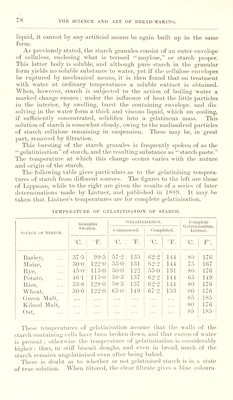
![liquid, it cannot by any artiticial means be again built up in tlie same form. As previously stated, the starch granules consist of an outer envelope of cellulose, enclosing what is tei-med “amylose,” or starch proper. This latter body is soluble, and altliough ])ure starch in the granular form yields no soluble substance to water, yet if the cellulo.se envelopes be ruptured by mechanical means, it is then found that on treatment with water at ordinary temperatures a soluble extract is obtained. When, however, starch is subjected to the action of boiling water a marked change ensues : under the iniluence of heat the little jiarticles ill the intei'ior, by swelling, burst the containing envelope, and dis¬ solving in the water form a thick and viscous liquid, which on cooling, if sulliciently concenti'ated, solidities into a gelatinous mass. This solution of starch is somewhat cloudy, owing to the undissolved particles of starch cellulose remaining in suspension. These may be, in great j)art, removed by tiltration. This bursting of the starch granules is frequently .spoken of as the “ gelatinisation” of starch, and the resulting substance as “ starch-})aste.” The temperature at which this change occurs varies with the nature and origin of the starch. The following table gives particulars as to the gelatinising tempera¬ tures of starch from dilferent sources. The tigures to the left are those of Lippman, while to the right are given the results of a series of later determinations made by Lintner, and published in 1889. It may be taken that Lintner’s temperatures are for complete gelatinisation. TEMPERATURE OF OF.L.VTlNRSATION OF STARCH. SOUllCE OF STAItCU. (immiles Swollen. (iHLATIMSATION. (,'onii)lete Gelatinisation, Lintner. Coinnienceil. Coniijleted. °C. ; °F. C. °F. °c. °¥. °c. F“. Marley, .8 7 •hi 99-') .97-2 1.99 G2-2 144 8(1 176 Maize, .90-U 1:12-0 .9.9 0 1.91 G2-2 144 79 167 Hve, llibU 50-0 122 .99-0 191 80 176 J*otato, 4(1-1 1 1 lo-O ;98-;? 197 G2-2 144 (1.9 149 Rice, .9;b8, 129 0 98-d 197 G2-2 144 80 17 6 Wheat, .90-0 i 122 0 G.9() 149 G7-2 199 80 176 (Ireen Malt, . . . S.9 189 Kilned Malt, 80 176 (tat. . . . 89 189 'J'hese tenq»(‘raturcs of gelatinisation assume that the walls of the starch containing cells have b(‘cn bi'oken down, and that cxci'ss of water is present; otherwise the tcunperature of gelatini.sation is considerably higher: tlius, in still' biscuit doughs, and even in bread, much of the starch remains ungelatinised (‘ven after bi'ing baked. There is doubt as to wlabher or not gelatinised starch is in a state of true solution. When tiltered, the clear liltrate gives a bhu' coloura-](https://iiif.wellcomecollection.org/image/b29315104_0112.jp2/full/800%2C/0/default.jpg)





 No text description is available for this image
 No text description is available for this image
 No text description is available for this image