A text-book of the science and art of bread-making : including the chemistry and analytic and practical testing of wheat, flour, and other materials employed in baking / by William Jago.
- William Jago
- Date:
- 1895
Licence: Public Domain Mark
Credit: A text-book of the science and art of bread-making : including the chemistry and analytic and practical testing of wheat, flour, and other materials employed in baking / by William Jago. Source: Wellcome Collection.
56/740 page 24
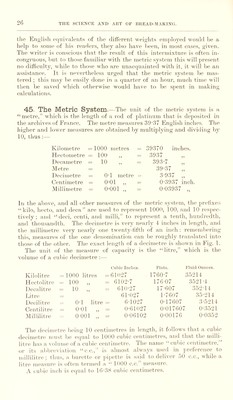
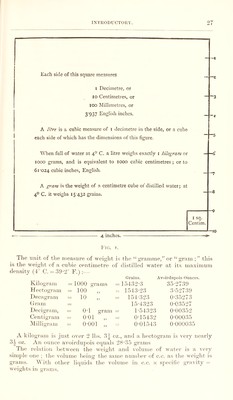
![THE SCIENCE AND ART OF J5UEA D-.M AKI NO. 27.4 X TGf) X 7801 —-xj-} y -(;q-= 7401 c.c iit X.T.P. =7‘401 litres. 7 101 X 1‘0712 = 1 t';)!! graius of CO.^. As 176 : 14-r)‘J :: 342 : 2S‘3.') grams of cane su<f:u-iisjiiired. 41. Gaseous Diffusion.--It is a well loiown fact that gases niix witli each other with I’emarkahle reiidiness. For instance, if in a large I'ooni a jar of chlorine is opened at the* level of the lioor, the presence of the gas may he detected hy its jiowerful odour, within a few sei^onds, in every j)art of the room. Fhe natural process hy which the chloi'ine is thus disseminated through the air is termed “gaseous diffusion;” it takes jilace between gases, even thougli the heavier is at fii'st at the lower level. In other words, a heavy gas will diffuse up into a super- incumhent light gas, while the light gas will make its way downwards and mix with the heavier one. In this way different gases, when placed in the same space, rajiidly ])roduce of themselves an uniform mixture. This jirocess of diffu.sion will also go on through a porous memhrane, as, for example, a thin diaiohragm of plaster of Paris or porous earthenware. I hus, if a vessel he divided into two jiarts by a thin partition of porous material, and the one lialf he filed with one gas and the other with another, they will he found after some time to have become thoroughly intermixed with each other. The rate of diffusion of all gases through such a diaphragm is not the same, but depends on their densities. The rate of diffusion of gases is inversely as the square root of their density. Thus, hydrogen and oxygen have respecti\ely densities of 1 and 16 ; hydrogen diffuses four times as rapidly as does oxygen. 42. Osmose and Dialysis.—Lifpiids which are miscible with each other—{i.e., readily mi.x when placed together)—also undergo diffusion more or less ra])idly. The laws governing diffusion of licpiids are more complex than tho.se affecting the diffusion of gases : not only gases, Imt also liquids, are capable of diffusion through a porous diaphragm ; such diffusion is termed “ Osmose ” Some of the most remarkable and impoi'tant ]>henomena of litpiid difl’usion ai'e those exhibited liy aipieous solutions of different substances. Thus, hff a .sort of drum head be maihi by stretching and fastening a ])i('ce of bullock's bladder, or either animal parchment or vegetable pai'c-hnumt paper, over a cylinder of some imjan-vious material, as glass or gutta jau'cha. h'loat this in a \'essel of jairi* water, and pour insidt' it a strong solution of common salt. The brine and the pure water will only lie separated from each othei’ hy the thin memhrane of bladder or other similar matm-ial. After the lapse of some hours it will be found tliat tlie solution of salt will have difl’used out through the imnubraiu' until the licpiid both out¬ side and inside the lloating \'essel has the same strength. I!y repeatedly changing tla^ water in the outer \'essel, the whoh* of the salt might be removed from the solution within tlu* cylinder. On tlu' othei- hand, if a .solution of gum were placed within the iiarchment drum, and sub- jecti'd to ja-eci.selv the same treatment, the gum would hi' found incap¬ able of diffusion through tlu' mmidirane. If a mixture of brine and](https://iiif.wellcomecollection.org/image/b29315104_0056.jp2/full/800%2C/0/default.jpg)



 No text description is available for this image
 No text description is available for this image
 No text description is available for this image