A text-book of the science and art of bread-making : including the chemistry and analytic and practical testing of wheat, flour, and other materials employed in baking / by William Jago.
- William Jago
- Date:
- 1895
Licence: Public Domain Mark
Credit: A text-book of the science and art of bread-making : including the chemistry and analytic and practical testing of wheat, flour, and other materials employed in baking / by William Jago. Source: Wellcome Collection.
93/740 page 61
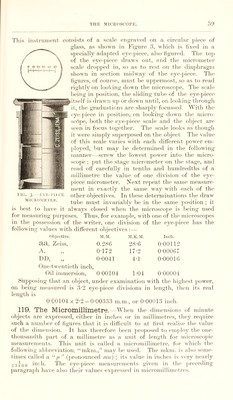
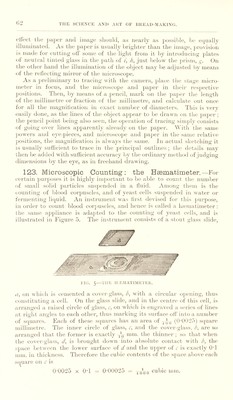
![liiri^e or too small; this is to hi' avoidi'il, as imi' ohjoct of microscopic examination is to detiniteh' ascertain the size of objects. It is the writer’s pi-actice when workintj; without sketcliini;- to note the measui-c- ineiits with the eye-])iece micrometer. W’hi'ii sketchiin;' he makes tracinj^s of sutlicient at least of the object to n'ive its actual dimensiojis bv a process similar in principle to that already desciilied. 122. Camera Lucida. For tracini^ with thi' microscojie an apjiliance has been invented, which is known as a “camera lucida;” there is also a modification termed a neutral tint camera. An ingenious combination of eye-piece and camera lucifla in one piece of apjtaratus is shown in section in fi 1,01 re 4. The principal jiortion of the tioure consists of the ordinary eye piece, a, l>, with its upper and lower lenses, r, d: the central dotted line, e, f, is the direct axis of vision through tlie microscope. At the top right hand of the figure is a glass ])risin, g, of peculiar shape. The angles of this are so arranged that a ray of light, jiassing in the direction //, /, is totally reflected at /, in the direction /, k, and again at k, is totallv reflected in the line k, 1. The result is that the eye placed over the apei’ture of the I'ye-piece, at w, re¬ ceives both rays of light, e, and h, i, k, /, which enter the eye parallel to each other. The result of this i.s that the eye sees simultaneously with the object under the micro.scope any other object placed in the direction of tlie line /, h; both aie combined and appear to be in the direct line of vision through the instrument. Conseijnently if a sheet of paper be placed under /, //, it and the microscope image apjx'ar to the eye to coincide. When wishing to use the camera, place the microscope in a vertical position, directly facing the source of light, and turn the camei'a so that the prism, is at the Tight hand side (as figui-ed). Pi'ocui'i' a box or other convenient stand of such ii height tluit its mipei' surface, wlii'ii ])liiced beside the microscope, is of the siimi! height as the mici'oscope stage. Place this box on the light hand side of the instiaiment, under the piism, g, so tluit the line, /, /g points to it. Foi- drawing purposes the most convenient ari’iingemi'nt is ;i small (h-jiwing “ block ” of hot pressed pajiei', sheet iifter sheet of which can be I'l'inoved as finished. Place this on the stand, undei'/, //, titkI look thi’ough the insti'ument; both object .and papei'should be seen in combination ; that is, the image should iippeai to lie super’iTosed on the p;ipei'. 'J’o pi'opeiiy gi't this I K;. 4.—CO.MlilNATION OF KYK-I'IFXF. AND CAMKKA I.UCIDA.](https://iiif.wellcomecollection.org/image/b29315104_0093.jp2/full/800%2C/0/default.jpg)




 No text description is available for this image
 No text description is available for this image
 No text description is available for this image