A dictionary of English and folk-names of British birds : with their history, meaning, and first usage, and the folk-lore, weather-lore, legends, etc., relating to the more familiar species / by H. Kirke Swann.
- Harry Kirke Swann
- Date:
- 1913
Licence: Public Domain Mark
Credit: A dictionary of English and folk-names of British birds : with their history, meaning, and first usage, and the folk-lore, weather-lore, legends, etc., relating to the more familiar species / by H. Kirke Swann. Source: Wellcome Collection.
275/304 page 259
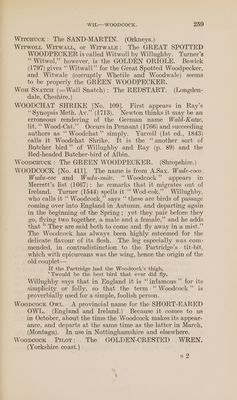
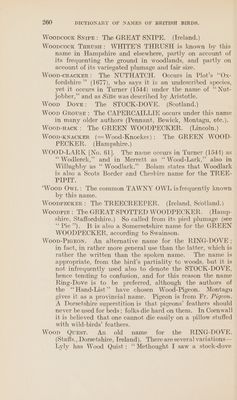
![Wiroxnuck: The SAND-MARTIN. (Orkneys.) WitwoLt Witwatt, or WitwaLeE: The GREAT SPOTTED WOODPECKER is called Witwoll by Willughby. Turner’s ‘ Witwol,”’ however, is the GOLDEN ORIOLE. Bewick (1797) gives “ Witwall” for the Great Spotted Woodpecker, and Witwale (corruptly Whetile and Woodwale) seems to be properly the GREEN WOODPECKER. Won Snatou (Wall Snatch): The REDSTART. (Longden- dale, Cheshire.) WOODCHAT SHRIKE [No. 109]. First appears in Ray’s ‘Synopsis Meth. Av.” (1713). Newton thinks it may be an erroneous rendering of the German name Wald-Kaize, lit. ““ Wood-Cat.”” Occurs in Pennant (1766) and succeeding authors as “ Woodchat”’ simply. Yarrell (Ist ed., 1843) calls it Woodchat Shrike. It is the “another sort of Butcher bird” of Willughby and Ray (p. 89) and the Red-headed Butcher-bird of Albin. Woopexuck: The GREEN WOODPECKER. (Shropshire.) WOODCOCK [No. 411]. The name is from A.Sax. Wude-coco, Wudu-coc and Wudu-snite. ‘“‘ Woodcock” appears in Merrett’s list (1667): he remarks that it migrates out of Treland. Turner (1544) spells it “* Wod-cok.” Willughby, who calls it “ Woodcock,” says “ these are birds of passage coming over into England in Autumn, and departing again in the beginning of the Spring; yet they pair before they go, flying two together, a male and a female,” and he adds that “ They are said both to come and fly away in a mist.” The Woodcock has always been highly esteemed for the delicate flavour of its flesh. The leg especially was com- mended, in contradistinction to the Partridge’s tit-bit, which with epicureans was the wing, hence the origin of the old couplet— If the Partridge had the Woodcock’s thigh, >Twould be the best bird that ever did fly. Willughby says that in England it is “infamous ”’ for its simplicity or folly, so that the term ‘‘ Woodcock ”’ is proverbially used for a simple, foolish person. Woopcock Ow. A provincial name for the SHORT-EARED OWL. (England and Ireland.) Because it comes to us in October, about the time the Woodcock makes its appear- ance, and departs at the same time as the latter in March. (Montagu). In use in Nottinghamshire and elsewhere. Woopnoock Pitot: The GOLDEN-CRESTED WREN. (Yorkshire coast.) $2](https://iiif.wellcomecollection.org/image/b28980414_0275.jp2/full/800%2C/0/default.jpg)
 No text description is available for this image
 No text description is available for this image
 No text description is available for this image