A complete system of farriery, and veterinary medicine : containi[n]g a compendium of the veterinary art, or an accurate description of the diseases of horses, and their mode of treatment; the anatomy and physiology of the foot, and the principles and practice of shoeing. With observations on stable management, feeding, exercise, and condition / by James White ... newly arranged by the publishers, in which are introduced the late and important treatises upon the glanders, farcy, staggers, inflammation of the lungs and bowels, the prevention and treatment of lameness, and precautions to be observed in purchasing horses. By the same author. Illustrated by eighteen elegant plates.
- White, James, -1825
- Date:
- 1832
Licence: Public Domain Mark
Credit: A complete system of farriery, and veterinary medicine : containi[n]g a compendium of the veterinary art, or an accurate description of the diseases of horses, and their mode of treatment; the anatomy and physiology of the foot, and the principles and practice of shoeing. With observations on stable management, feeding, exercise, and condition / by James White ... newly arranged by the publishers, in which are introduced the late and important treatises upon the glanders, farcy, staggers, inflammation of the lungs and bowels, the prevention and treatment of lameness, and precautions to be observed in purchasing horses. By the same author. Illustrated by eighteen elegant plates. Source: Wellcome Collection.
Provider: This material has been provided by the National Library of Medicine (U.S.), through the Medical Heritage Library. The original may be consulted at the National Library of Medicine (U.S.)
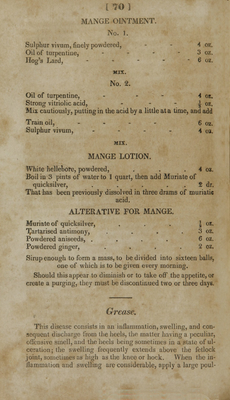
![[69] No. 2. Tartarised antimony, - - - - 2^ oe. Powdered ginger, - - - 1^ ok. Opium, - - - - ^ oz. Sirup enough to form a mass, to be divided into eight balls. Surfeit. This absurd term is given by farriers to a disease of the skin, consisting in small tumors or knobs which appear suddenly in various parts of the body, sometimes in consequence of drink- ing largely of cold water, when the body is unusually warm; but it appears frequently without any manifest cause. It may be easily cured by bleeding moderately, or giving a laxative ball: sometimes, indeed, it goes off without any medical as- sistance. There is another disease of the skin, of the same name, which is generally more obstinate, and attacks horses that are hidebound and out of condition. In this a great num- ber of very small scabs may be left in various parts of the bo- dy; the horse is frequently rubbing himself; and sometimes the hair falls off from those parts which he rubs. This complaint approaches to the nature of mange, and requires the same treat- ment, assisted by a generous diet, good grooming, and regular exercise. (See Condition and Humors, Appendix.) Mange. This disease is seldom met with except in stables where scarcely any attention is paid to the horses, and where their food is of the worst quality; it is certainly very contagious, and may in this way attack horses that are in good condition. It is known to exist by the horse constantly rubbing or biting him- self, so as to remove the hair, and sometimes produce ulcera- tion ; the hair of the main and tail frequently falls off, and small scabs are observable about the roots of that which remains. The mange is, I believe, a local disease, and requires only the following ointment or lotion for its removal: in obstinate cases, however, it may be advisable to try the effect of the following alterative.](https://iiif.wellcomecollection.org/image/b21163728_0073.jp2/full/800%2C/0/default.jpg)