Nutrition / [Burroughs Wellcome & Co. (The Wellcome Foundation Ltd.)].
- Burroughs Wellcome & Company
- Date:
- [1937?]
Licence: Public Domain Mark
Credit: Nutrition / [Burroughs Wellcome & Co. (The Wellcome Foundation Ltd.)]. Source: Wellcome Collection.
5/32 page 3
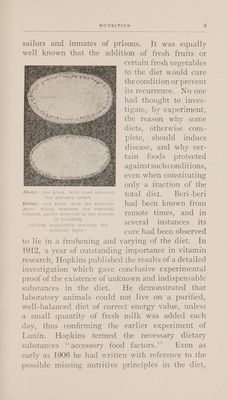
![sailors and inmates of prisons. It was equally well known that the addition of fresh fruits .or certain fresh vegetables to the diet would cure the condition or prevent its recurrence. No one had thought to inves- tigate, by experiment, the reason why some diets, otherwise com- plete, should induce disease, and why cer- tain foods protected againstsuchconditions, even when constituting 3 f only a fraction of the Above: rice grain, with husk removed total diet. Beri-beri but pericarp intact. Below: rice grain, with the aleurone had been known from layer, which contains the essential . ° vitamin, partly removed in the process remote times, and in of polishing. ] a st L Milling completely removes the severa Instances its sig gia whee Sat cure had been observed to lie in a freshening and varying of the diet. In 1912, a year of outstanding importance in vitamin research, Hopkins published the results of a detailed investigation which gave conclusive experimental proof of the existence of unknown and indispensable substances in the diet. He demonstrated that laboratory animals could not live on a_ purified, well-balanced diet of correct energy value, unless a small quantity of fresh milk was added each day, thus confirming the earlier experiment of Lunin. Hopkins termed the necessary dietary substances ‘‘accessory food factors.’’ Even as early as 1906 he had written with reference to the possible missing nutritive principles in the diet,](https://iiif.wellcomecollection.org/image/b33462148_0005.jp2/full/800%2C/0/default.jpg)