Technical mycology : the utilization of micro-organisms in the arts and manufactures... / by Franz Lafar. Vol.II, pts1&2, Eumycetic fermentation.
- Lafar, Franz, 1865-1938.
- Date:
- 1903-1910
Licence: In copyright
Credit: Technical mycology : the utilization of micro-organisms in the arts and manufactures... / by Franz Lafar. Vol.II, pts1&2, Eumycetic fermentation. Source: Wellcome Collection.
Provider: This material has been provided by London School of Hygiene & Tropical Medicine Library & Archives Service. The original may be consulted at London School of Hygiene & Tropical Medicine Library & Archives Service.
19/274 page 7
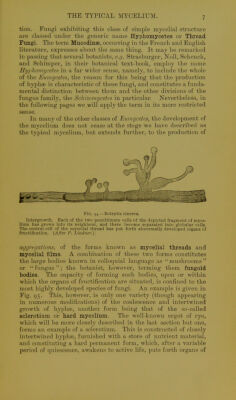
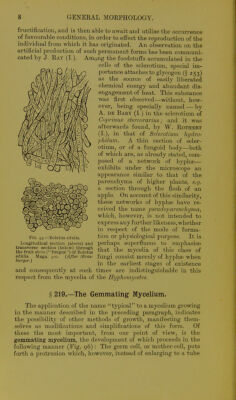
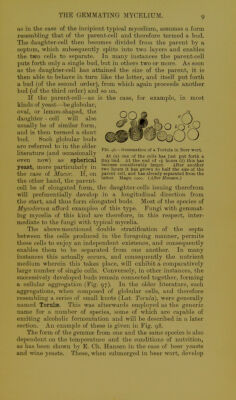
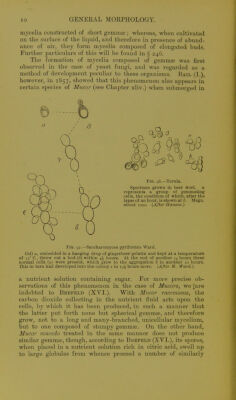
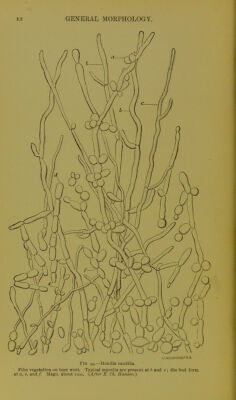
![tion. Fungi exhibiting this class of simple mycelial structure are classed under the generic name Hyphomycetes or Thread Fungi. The term Mucedinse, occurring in the Fi'ench and English literatm-e, expresses about the same thing. It may be remai'ked in passing that several botanists, e.g. Strasburger, Noll, Schenck, and Schimper, in their botanical text-book, employ the name HyiJiomycetes in a far wider sense, namely, to include the whole of the Eumycetes, the reason for this being that the production of hyphse is characteristic of these fungi, and constitutes a funda- mental distinction between them and the other divisions of the fungus family, the Schizomycetes in particular. Nevertheless, in the following pages we will apply the term in its more restricted sense. In many of the other classes of Eumijcetes, the development of the mycelium does not cease at the stage we have described as the typical mycelium, but extends further, to the production of Pig. 94.—Botrytis cinerea. Intergrowth. Each of the two penultimate nells of the depicted fragment of myce- lium has grown iuto its neighbour, and there become separated into globular cells. The central cell of the mycelial thread has put forth abnormally developed organs of fructification. (After P. Lindner.)] aggregations, of the forms known as mycelial threads and mycelial films. A combination of these two forms constitutes the large bodies known in colloquial language as mushrooms or fungus; the botanist, however, terming them fungoid bodies. The capacity of forming such bodies, upon or within which the organs of fructification are situated, is confined to the most highly developed species of fungi. An example is given in Fig. 95. This, however, is only one variety (though appeai-ing in numerous modifications) of the coalescence and intertwined growth of hyphse, another form being that of the so-called sclerotium or hard mycelium. The well-known ergot of rye, which will be more closely described in the last section but one, forms an example of a sclerotium. This is constructed of closely intertwined hyphse, furnished with a store of nutrient material, and constituting a hard permanent form, which, after a variable period of quiescence, awakens to active life, puts forth organs of](https://iiif.wellcomecollection.org/image/b21353153_0021.jp2/full/800%2C/0/default.jpg)