Contributions to the craniology of the people of the empire of India / by Sir Wm. Turner.
- William Turner
- Date:
- 1899-1901
Licence: In copyright
Credit: Contributions to the craniology of the people of the empire of India / by Sir Wm. Turner. Source: Wellcome Collection.
Provider: This material has been provided by The Royal College of Surgeons of England. The original may be consulted at The Royal College of Surgeons of England.
77/136 (page 79)
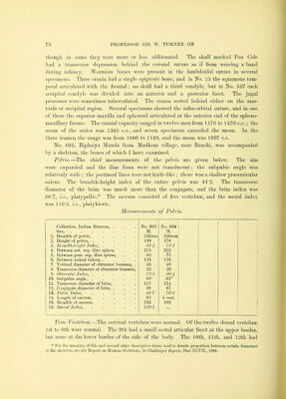
![each a large single costal facet at the side of the body. The transverse process of the 10th dorsal had no costal facet, and those of the 11th and 12th had the usual three tubercles. The lumbar vertebrae were of the customary shape. The vertical diameter of their bodies in front and behind was as follows :— A.V.D. P.V.D. Indices. 1st lumbar. 24 mm. 25 mm. 104 2nd „ 23 „ 26 „ 113 3rd „ 23 „ 26 „ 113 4tb „ 20 „ 22 W-J j, 110 5tb „ 21 „ 21 100 Total 111 mm. Total 120 mm. Mean 108'1 In this skeleton the upper four vertebrae had the posterior vertical diameter longer than the anterior. It is customary to find the antero-vertical diameter of the 5th vertebra longer than the postero-vertical, but in this specimen they were equal. The mean general index of the series of five vertebrae was as high as 108T, which places the lumbar spine in the koilorachic group. Up])er Limb.—Clavicles slender, right 188 mm., left 136 mm. long; subclavian groove shallow. Scapulae; right, 143 mm. long, 105 broad, index 73‘4 ; left, 150 mm. long, 106 broad, index 70’6. Supra-scapular notch shallow and wide, but with a distinct border. Humerus with shallow musculo-spiral groove and moderate muscular impressions, no supra-condylar process or inter-condylar foramen. Bones of forearm not specially noticeable. Kadio-humeral index, 83'3 or dolichokerkic. Humerus, head to troclilea, Radius to tip of styloid, . ,, base ,, Ulna to tip of styloid, „ articular surface, . Right. Left. 307 mm. 312 mm. 256 „ 255 „ 252 „ 250 „ 281 „ 281 „ 276 „ 278 „ Lower imb.—Femur with linea aspera and external condylar ridge fairly well marked, also the trochanters and gluteal ridge; no platymery; articular area on internal condyle prolonged forwards and lying in the same transverse plane as the origin of the inner head of the gastrocnemius; popliteal surface plano-concave. Tibia with the head retroverted; condylar surfaces with shallow concavities; antero- posterior diameter of shaft of right tibia in plane of nutrient foramen, 36 mm. ; transverse diameter in same plane 25 mm. ; index of platyknemia 69‘4 ; the corre- sponding diameters of the left bone were 37 and 24 mm. No articular facet on the front of lower end of left tibia contiuuous with the astragalar area was seen, but a slight indication of one was present in the right bone. The fibulae had strong oblique ridges and a deep concavity for the origin of the tibialis posticus. No. 604, referred to on p. 77, and marked Jattia Munda from Bhowro village, is so different in configuration from the other Munda crania that there can, I think, be little doubt that it has been erroneously named by the collector. The skull is brachycephalic, 80’5, in its proportions and form. It was rounded in outline when seen from the](https://iiif.wellcomecollection.org/image/b22415798_0079.jp2/full/800%2C/0/default.jpg)