Contributions to the craniology of the people of the empire of India / by Sir Wm. Turner.
- William Turner
- Date:
- 1899-1901
Licence: In copyright
Credit: Contributions to the craniology of the people of the empire of India / by Sir Wm. Turner. Source: Wellcome Collection.
Provider: This material has been provided by The Royal College of Surgeons of England. The original may be consulted at The Royal College of Surgeons of England.
91/136 (page 93)
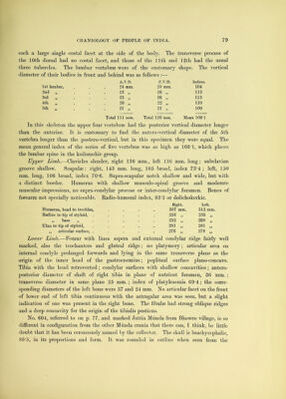
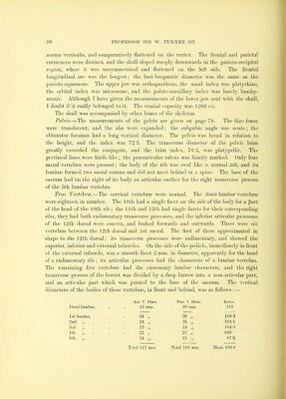
![the number of crania in the Indian Museum marked Uriya, most of which had been obtained from the medical school of Calcutta. ' I have examined thirty skulls from the Indian Museum, marked Uriya in the list sent to me, and in addition I have received from my friend Major Bannerman, M.D., two specimens which he had collected at Baghmari village in Orissa. The crania were by no means a homogeneous series, but varied materially in form and proportions, so that it would be impossible to draw up a description which would be generally applicable. If we take the proportion of length and breadth to guide us in our examination, we shall find that the crania can readily be arranged in three groups. The larger number, seventeen in all, have the length-breadth index below 75, and in form and proportions are dolichocephalic; in ten skulls the corresponding index is between 75 and 80, mesaticephalic; whilst in five crania this index was upwards of 80, brachycephalic. Dolichoce'plialic Series.—Of the seventeen crania belonging to this group, fifteen were apparently males and two females. They were all adults, with perhaps two ex- ceptions about 20 and 21 years of age. When examined in the norma verticalis, they were seen to be elongated and ovoid in outline, with side walls approaching the vertical and with no great difference between the frontal and parietal transverse diameters. The parietal eminences were fairly marked. As a rule, the sagittal line was not raised above the general plane of the vertex, and the slope from it to the parietal eminence was moderate. In the majority the parieto-occipital region sloped gently backwards and downwards, but in four specimens it was inclined more abruptly, and in three of these it showed a want of symmetry, as if modified by artificial pressure. In No. 232 this character was most distinct, and in it was also seen a transverse post-coronal depression, as if from wearing a tight band during infancy. In No. 42, the elongated form was exaggerated and the skull was hyper-dolichocephalic; the sagittal suture was unossified, but the right parieto-mastoid and adjoining parieto-squamous were closed. The mean cephalic index of the series was 72‘2. The male skulls in the greatest length ranged from 171 to 194 mm., but the majority were between 180 and 187 mm. In the greatest.breadth they ranged from 124 to 139 mm., but the majority were between 127 and 134 mm. In no specimen was the occipital arc the longest; in several, the frontal and parietal longitudinal arcs were equal or almost equal; in a few, the frontal materially exceeded the parietal, in others the proportion was reversed. The mean vertical index of the series was 7 5'4, and in only three crania was the basibregmatic height less than the greatest breadth. (Table VI.) The glabella and supra-orbital ridges had, as a rule, but little prominence, though well marked in the man from Baghmari village. In the men the forehead was slightly receding, but in the women it was almost vertical. The nasion was only slightly de- pressed ; as a rule, the bridge of the nose projected forwards, but in a few it was not prominent. The nasal spine of the superior maxillse was distinct as a rule, and the fioo]’ of the nose was separated from the incisive region of the maxilla by a sharp ridge.](https://iiif.wellcomecollection.org/image/b22415798_0093.jp2/full/800%2C/0/default.jpg)