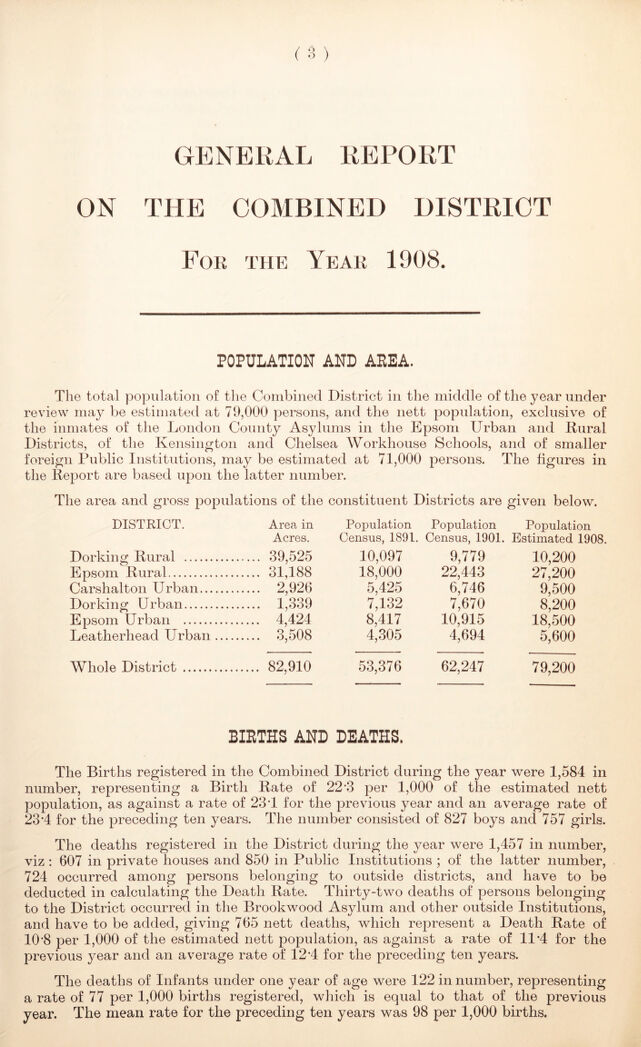
[Report 1908] / Medical Officer of Health, Dorking R.D.C., Epsom R.D.C., Carshalton U.D.C., Dorking U.D.C., Epsom U.D.C., Leatherhead U.D.C.
- Dorking (England). Rural District Council.
- Date:
- 1908
Licence: Attribution 4.0 International (CC BY 4.0)
Credit: [Report 1908] / Medical Officer of Health, Dorking R.D.C., Epsom R.D.C., Carshalton U.D.C., Dorking U.D.C., Epsom U.D.C., Leatherhead U.D.C. Source: Wellcome Collection.
6/88 page 6
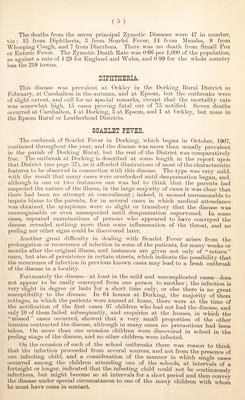
![In the Carshalton, Epsom, and Leatherhead Urban Districts, application is made to the Sanitary Ins})ectors by tlie medical practitioners for removal of patients to the Isolation Hosjhtals, at the time of notification; in the Epsom linral District, application is usually made by tele{)hone directly to the Matron of the Hospital, and in the Dorking Districts it is made to the Clerk to the Joint Hospital Board. The houses are at once visited by the Inspectors, who obtain the particulars of the cases, fumigate the rooms with formalin, supply disinfectants and explain their use, and make a list of infected articles for removal to the hospitals for stoving ; in tlie Dorking Urban District fumigation is done by the owners under notice, and not by the Inspector. Notice is served upon the owners to strip the walls and limewash the ceilings in any cases in which it is required, and the occupiers are instructed as to the cleansing of the rooms. Enquiries are made by me as to any previous illness in the houses, and any persons who have had sym])toms of the disease are examined. Notices are sent to the School Attendance Officers to exclude children from the infected houses, the schools are visited if there is reason to suspect that they may be acting as a centre of infection, suspected children are examined and enquiries are made at the homes of children who are absent on account of doubtful illness. Dr. Seaton’s recent report upon Scarlet Fever to the Surrey County Council shows that the failure of hospital isolation to achieve the results hoped for is due to a great extent to the fact that a large proportion, amounting to about fiO per cent, of the secondary patients, are already infected before the nature of the disease is recognised in the first patient, and that a certain number of the remaining members of tlie household, who are saved from exposure to infection for the time by the removal of the patients, fail with the disease after their return. These points are illustrated in the outbreak at Dorking, and to a less extent in the other parts of the combined District. In many cases the illness is of such a comparatively trivial character that the parents do not consider it necessary to obtain medical advice, but it is obvious that the success of hospital isolation is dependent upon the earlier recognition of the nature of the illness. An attempt to guard against such cases being overlooked was made by visiting and examining at their homes children who were reported by the School Teachers to be absent suffering from symptoms of the disease, and it will be seen, especially on reference to the Dorking Urban Report, that many cases were discovered thereby. It is true that this system of notification did not lead in several instances to the discovery of the cases in the early stage of the illness, but as soon as the Teachers understood what slight symptoms might indicate an attack of the disease, they sent me more complete and prompt information, and at all times they gave me valuable assistance in this respect. ENTEBIC EEVEB. Only three cases of this disease were reported in private houses, and two of the patients contracted the illness while they were absent from the District. There were three cases in the London County Asylums and one case at a Public School. MEASLES. A wide-spread epidemic of this disease prevailed throughout the District during the autumn. Many visits were paid to the Schools, and advice was given as to the exclusion of children and disinfection, but in many Schools the presence of the disease was not discovered until a considerable number of the children failed, and the spread was so rapid as to necessitate closure. The fourteen deaths occurred among young children who were not attending school.](https://iiif.wellcomecollection.org/image/b29164771_0006.jp2/full/800%2C/0/default.jpg)