Bibliographical notes on the English translation of Polydore Vergil's work, 'De inventoribus rerum' / communicated to the Society of Antiquaries by John Ferguson.
- John Ferguson
- Date:
- 1888
Licence: Public Domain Mark
Credit: Bibliographical notes on the English translation of Polydore Vergil's work, 'De inventoribus rerum' / communicated to the Society of Antiquaries by John Ferguson. Source: Wellcome Collection.
Provider: This material has been provided by The Royal College of Surgeons of England. The original may be consulted at The Royal College of Surgeons of England.
36/38 page 34
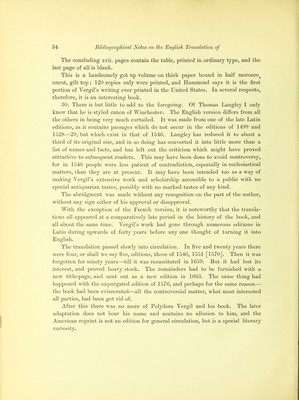
![The concluding xvii. pages contain the table, printed in ordinary type, and the last page of all is blank. This is a handsomely got up volume on thick paper bound in half morocco} uncut, gilt top; 120 copies only were printed, and Hammond says it is the first portion of Vergil's writing ever printed in the United States. In several respects, therefore, it is an interesting book. 30. There is but little to add to the foregoing. Of Thomas Langley I only know that he is styled canon of Winchester. The English version differs from all the others in being very much curtailed. It was made from one of the late Latin editions, as it contains passages which do not occur in the editions of 1499 and 1528—29, but which exist in that of 1546. Langley has reduced it to about a third of its original size, and in so doing has converted it into little more than a list of names and facts, and has left out the criticism which might have proved attractive to subsequent readers. This may have been done to avoid controversy, for in 1546 people were less patient of contradiction, especially in ecclesiastical matters, than they are at present. It may have been intended too as a way of making Vergil’s extensive work and scholarship accessible to a public with no special antiquarian tastes, possibly with no marked tastes of any kind. The abridgment was made without any recognition on the part of the author, without any sign either of his approval or disapproval. With the exception of the French version, it is noteworthy that the transla- tions all appeared at a comparatively late period in the history of the book, and all about the same time. Vergil’s work had gone through numerous editions in Latin during upwards of forty years before any one thought of turning it into English. The translation passed slowly into circulation. In five and twenty years there were four, or shall we say five, editions, those of 1546, 1551 [1570]. Then it was forgotten for ninety years—till it was resuscitated in 1659. But it had lost its interest, and proved heavy stock. The remainders had to be furnished with a new title-page, and sent out as a new edition in 1663. The same thing had happened with the expurgated edition of 1576, and perhaps for the same reason— the book had been eviscerated—all the controversial matter, what most interested all parties, had been got rid of. After this there was no more of Polydore Vergil and his book. The later adaptation does not bear his name and contains no allusion to him, and the American reprint is not an edition for general circulation, but is a special literary curiosity.](https://iiif.wellcomecollection.org/image/b2228915x_0038.jp2/full/800%2C/0/default.jpg)


 No text description is available for this image
 No text description is available for this image
 No text description is available for this image