The chemistry of pharmacy : an exposition of chemical science in its relations to medicinal substances according to a practical and original plan / by R. Rother.
- Rother, Reinhold.
- Date:
- 1888
Licence: Public Domain Mark
Credit: The chemistry of pharmacy : an exposition of chemical science in its relations to medicinal substances according to a practical and original plan / by R. Rother. Source: Wellcome Collection.
51/84 (page 43)
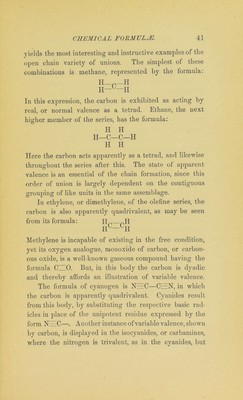
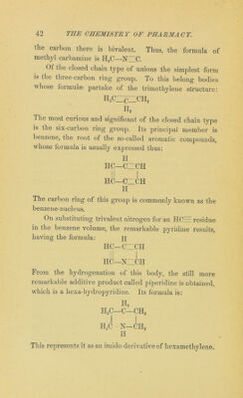
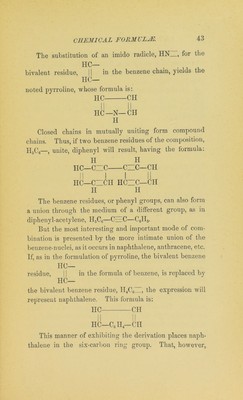
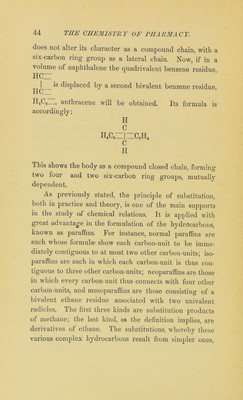
![The substitution of an imido radicle, HN—, for the HC— bivalent residue, ] | in the benzene chain, yields the TIC- noted pyrroline, whose formula is: HC CTI II II HC —N— CH H Closed chains in mutually uniting form compound chains. Thus, if two benzene residues of the composition, TI5C6—, unite, diphenyl will result, having the formula: H H IIC—CUC CIZC—CH II ! I II HC—CUCIT HCHC—CIT II TI The benzene residues, or phenyl groups, can also form a union through the medium of a different group, as in diphenyl-acetylene, H5C6—C—C—C6II5. But the most interesting and important mode of com- bination is presented by the more intimate union of the benzene-nuclei, as it occurs in naphthalene, anthracene, etc. If, as in the formulation of pyrroline, the bivalent benzene HC— residue, 11 in the formula of benzene, is replaced by HC— the bivalent benzene residue, II4C6ZI, the expression will represent naphthalene. This formula is: IIC CH HC—CJI— CH This manner of exhibiting the derivation places naph- thalene in the six-carbon ring group. That, however,](https://iiif.wellcomecollection.org/image/b28092983_0051.jp2/full/800%2C/0/default.jpg)