Some observations on Dr. Rush's work, on "the diseases of the mind" : with remarks on the nature and treatment of insanity / by George Hayward.
- George Hayward
- Date:
- [1818]
Licence: Public Domain Mark
Credit: Some observations on Dr. Rush's work, on "the diseases of the mind" : with remarks on the nature and treatment of insanity / by George Hayward. Source: Wellcome Collection.
Provider: This material has been provided by the National Library of Medicine (U.S.), through the Medical Heritage Library. The original may be consulted at the National Library of Medicine (U.S.)
1/16
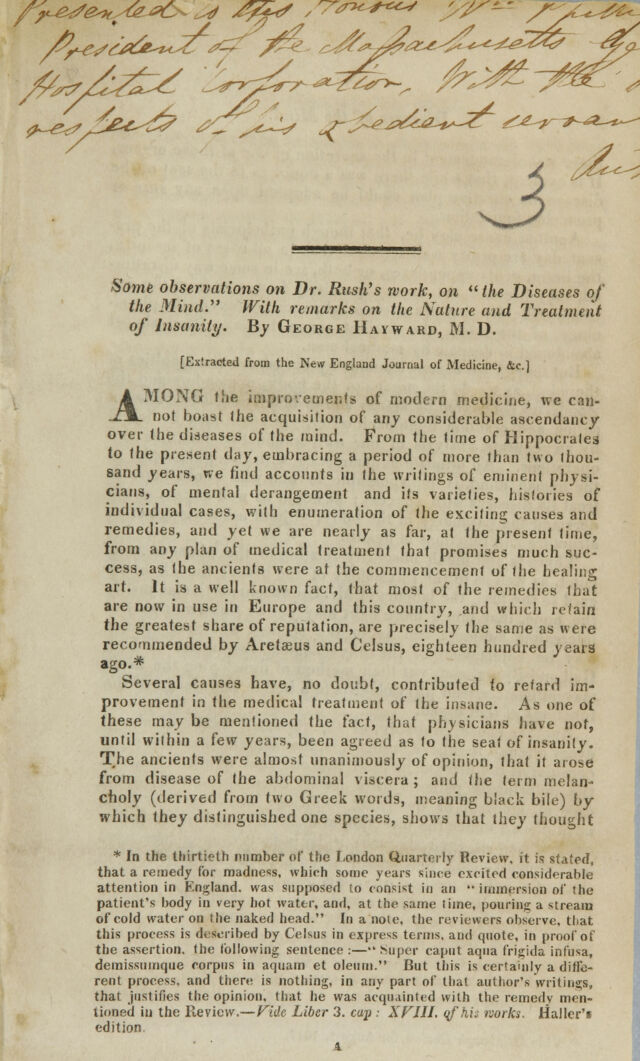
![^-e^f Some observatio7is on Dr. Rush's work, on the Diseases of the Mind.'' With remarks on the Nature and Treatment of Insanity. By George Havward, M. D. [Extracted from the New England Journal of Medicine, &c] AMONG the improvements of modern medicine, we can- not boast the acquisition of any considerable ascendancy over the diseases of the mind. From the time of Hippocrates to the present day, embracing a period of more than two thou- sand years, we find accounts in the writings of eminent physi- cians, of mental derangement and its varieties, histories of individual cases, with enumeration of the exciting causes and remedies, and yet we are nearly as far, at the present time, from any plan of medical treatment that promises much suc- cess, as the ancients were at the commencement of the healing art. It is a well known fact, that most of the remedies that are now in use in Europe and this country, and which retain the greatest share of reputation, are precisely the same as were recommended by Aretaeus and Celsus, eighteen hundred years ago.* Several causes have, no doubt, contributed to retard im- provement in the medical treatment of the insane. As one of these may be mentioned the fact, that physicians have not, until wilhin a few years, been agreed as to the seat of insanity. The ancients were almost unanimously of opinion, that it arose from disease of the abdominal viscera ; and the term melan- choly (derived from two Greek words, meaning black bile) by which they distinguished one species, shows that they thought * In the thirtieth nnmher of the London Quarterly Review, it is stated, that a remedy for madness, which some years since excited considerable attention in England, was supposed to consist in an immersion of the patient's body in very hot water, and, at the same time, pouring a stream of cold water on the naked head. In a note, the reviewers observe, that this process is described by Celsus in express terms, and quote, in proof of the assertion, the following sentence :— Super caput aqua frigida infusa, demissumque corpus in aquam et oleum. But this is certainly a diffe- rent process, and there is nothing, in any part of that author's writings, that justifies the opinion, that he was acquainted with the remedy men- tioned iu the Review.—Fide Liber 3. cap : XV1I1. qfhij works. Haller's edition](https://iiif.wellcomecollection.org/image/b21127566_0001.jp2/full/800%2C/0/default.jpg)