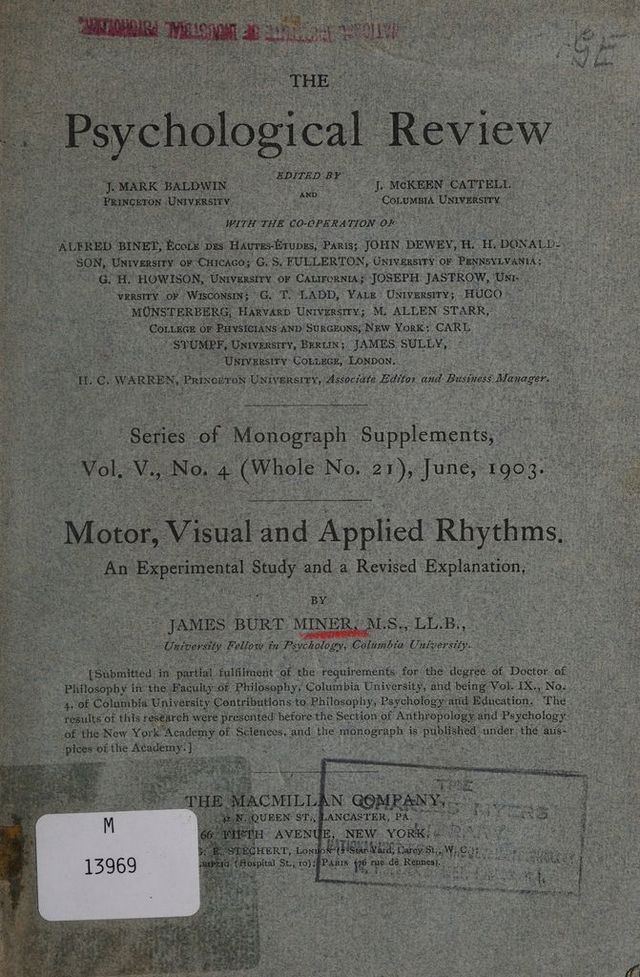
Motor, visual and applied rhythms : an experimental study and a revised explanation / by James Burt Miner.
- Miner, J. B. (James Burt), 1873-
- Date:
- 1903
Licence: Public Domain Mark
Credit: Motor, visual and applied rhythms : an experimental study and a revised explanation / by James Burt Miner. Source: Wellcome Collection.
12/118 page 6
![pulse or some other regular rhythm is chosen. Fatigue, for example, is supposed to rise and fall, and might explain the ten- dency to favor a certain length of group. But a condition of fatigue could not correlate in consciousness with the grouping of a series of stimuli in twos whether they be .1 or I sec. apart. A constant brain pulse or rhythm of nervous discharge, if there is any such regular rhythm taking place, would present the same difficulty. Weare not justified in supposing that any con- stant rhythm could be changed and distorted to provide a group- ing accompaniment of various periods. Meumann suggests something like a brain pulse in connection with his attention explanation, which I shall treat under that head. MacDougall also allows for such a possible explanation of rhythm, in addi- tion to the factor of kinzesthetic sensations which he mentions. He says: ‘‘ We may conceive a periodical facilitation and inhi- bition of nervous activity to arise from the relation between the periodicity of its own rhythm of functioning and certain inter- vals in the objective series of stimulations. If such a physio- logical rhythm appears in the functioning of the central nervous — system, a periodic increase and decrease should occur in the intensity of the sensations codrdinated with a series of unchang- ing stimulations, according as the elements were codrdinated with positive or negative phases of the nervous activity.” * He is speaking here, I] take it, of a continued rhythm of action which the nervous mechanism may show in some con- stant way. If there were a regular increase and decrease in the intensity of the current, either from the sense organ or in the brain, we should have a real change in sensations. ‘This would be fundamentally different from the illusion of change on ac- count of kinzsthetic accompaniments, which I suggest. The supposition of such a brain pulse, with the idea that it is com- paratively constant, has the same inadequacy as other organic rhythms. 2. Attention. There is considerable confusion in the use of the word attention by those writers who would ascribe the unitary feeling of the group to it. The wave of attention may mean the fact 1 Psychol. Rev., IX., 465.](https://iiif.wellcomecollection.org/image/b29012107_0012.jp2/full/800%2C/0/default.jpg)