Training to reason : an investigation into the possibility of training in seeing relations of evidence / by Marjorie Hill.
- Marjorie Hill Allee
- Date:
- 1936
Licence: In copyright
Credit: Training to reason : an investigation into the possibility of training in seeing relations of evidence / by Marjorie Hill. Source: Wellcome Collection.
34/76 (page 32)
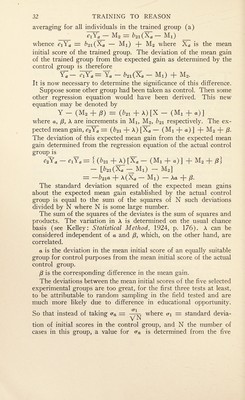
![averaging for all individuals in the trained group (a) _ M2 = b21(Xa - MO _ whence eiYa — b2i(X.a — Mi) -f- M2 where Xa is the mean initial score of the trained group. The deviation of the mean gain of the trained group from the expected gain as determined by the control group is therefore Yl- eiYa = T« — b21(Xa - MO + M2. It is now necessary to determine the significance of this difference. Suppose some other group had been taken as control. Then some other regression equation would have been derived. This new equation may be denoted by Y- (M2 + £) = (b2! + A)[X- (Mj + a)] where a, (3, A are increments in Mi, M2, b21 respectively. The ex¬ pected mean gain, e2Ya = (b21 + A) [Xa — (Mi + a) ] + M2 (3. The deviation of this expected mean gain from the expected mean gain determined from the regression equation of the actual control group is e2Y a — e±Ya = { (b2\ -j- A) [Xa — (Mi-f-a)] -J- M2 -f- (3} - [b2i(Xi- Mi) - Mo] — —b2ia -{- A(Xa — Mi) — Aa *-j- (3. The standard deviation squared of the expected mean gains about the expected mean gain established by the actual control group is equal to the sum of the squares of N such deviations divided by N where N is some large number. The sum of the squares of the deviates is the sum of squares and products. The variation in A is determined on the usual chance basis (see Kelley: Statistical Method, 1924, p. 176). A can be considered independent of a and /3, which, on the other hand, are correlated. a is the deviation in the mean initial score of an equally suitable group for control purposes from the mean initial score of the actual control group. f3 is the corresponding difference in the mean gain. The deviations between the mean initial scores of the five selected experimental groups are too great, for the first three tests at least, to be attributable to random sampling in the field tested and are much more likely due to difference in educational opportunity. So that instead of taking <ra cr i VN where <ti = standard devia¬ tion of initial scores in the control group, and N the number of cases in this group, a value for o-a is determined from the five](https://iiif.wellcomecollection.org/image/b29932063_0034.jp2/full/800%2C/0/default.jpg)