A history of chemical theory from the age of Lavoisier to the present time / by AD. Wurtz, translated and edited by Henry Watts.
- Charles-Adolphe Wurtz
- Date:
- 1869
Licence: Public Domain Mark
Credit: A history of chemical theory from the age of Lavoisier to the present time / by AD. Wurtz, translated and edited by Henry Watts. Source: Wellcome Collection.
216/288 page 204
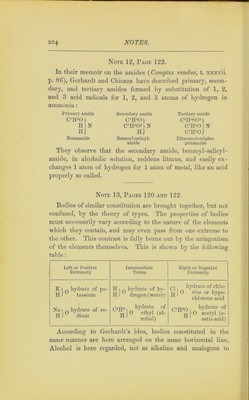
![Note 12, Page 122. In tlieir memoir on the amides (Comptes rendus, t. xxxvii. p. 86), Gerhardt and Chiozza hâve described primary, secon- dary, and tertiary amides formed by substitution of 1, 2, and 3 acid radicals for 1, 2, and 3 atoms of hydrogen in ammonia : Primary amide Secondary amide Tertiary amide C7II50 ) C7H50) OTPSO® ) h In C7H5021N C’IPO N h] hJ C7H50 ] Benzamide Benzoyl-salicyl- amide Dibenzoyl-sulpho- plenamide They observe that the secondary amide, benzoyl-salicyl- amide, in alcoholic solution, reddens litmus, and easily ex- changes 1 atom of hydrogen for 1 atom of métal, like an acid properly so called. Note 13, Pages 120 and 122. Bodies of similar constitution are brought together, but not confused, by the theory of types. The properties of bodies must necessarily vary according to the nature of the éléments winch they contain, and may even pass from one extreme to the other. This contrast is fully borne out by the antagonism of the éléments themselves. This is shown by the following table : Beft or Positive Intermediate Bight or Négative Extremity Terms Extremity Ki q hydrate of po- il J tassium II i q hydrate of hy- H J drogen (water) hydrate of chlo- g | (J rme or hypo- chlorous acid Na i ^ hydrate of so- H ) U dium P2TT5, hydrate of tt 0 ethyl (al- a eohol) C5H30 i n hId™,te of jj | 0 acetyl (a- cetic acid) According to Gerhardt’s idea, bodies constituted in the sarne manner are here arranged on the sanie horizontal line. Alcoliol is here regarded, not as alkaline and analogous to](https://iiif.wellcomecollection.org/image/b24850007_0216.jp2/full/800%2C/0/default.jpg)