A history of chemical theory from the age of Lavoisier to the present time / by AD. Wurtz, translated and edited by Henry Watts.
- Charles-Adolphe Wurtz
- Date:
- 1869
Licence: Public Domain Mark
Credit: A history of chemical theory from the age of Lavoisier to the present time / by AD. Wurtz, translated and edited by Henry Watts. Source: Wellcome Collection.
218/288 page 206
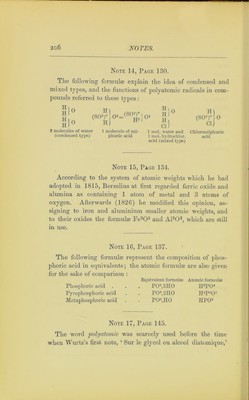
![Note 14, Page 130. The following formulée explain the idea of condensed and inixed types, and the functions of polyatomic radicals in com- pounds referred to these types : H II H II }° (so-?lo2=(so!]l'j.o2 h) Hl0 H1U H> Cl) 2 molécules of water 1 molécule of sul- 1 mol. water and (condensed type) phuric acid 1 mol. hydrochlor. acid (mixed type) II (SO2) Cl O Chlorosulphuric acid Note 15, Page 134. According to the System of atomic weights which he had adopted in 1815, Berzelius at first regarded ferrie oxide and alumina as containing 1 atom of métal and 3 atoms of oxygen. Afterwards (1826) he modified this opinion, as- signing to iron and aluminium smaller atomic weights, and to tlieir oxides the formulæ Fe203 and A1203, which are still in use. Note 16, Page 137. The following formulæ represent the composition of plios- phoric acid in équivalents ; the atomic formulæ are also given for the sake of comparison : Equivalent formulæ Atomic formulæ Phosphoric acid . . . PO5,3IIO H3P04 Pyrophosphoric acid . . P05,2H0 H4P207 Metaphosphoric acid . . PO4,HO HPO3 Note 17, Page 145. The word polj/atomic was scarcely used before the time when Wurtz’s first note, ‘ Sur le glycol ou alcool diatomique,’](https://iiif.wellcomecollection.org/image/b24850007_0218.jp2/full/800%2C/0/default.jpg)