A laevo-rotatory modification of quercitol / by Frederick B. Power and Frank Tutin.
- Frederick Belding Power
- Date:
- [1904.]
Licence: In copyright
Credit: A laevo-rotatory modification of quercitol / by Frederick B. Power and Frank Tutin. Source: Wellcome Collection.
5/12 page 626
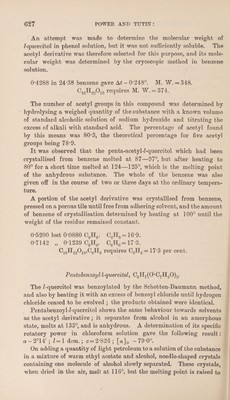
![colourless prisms containing one molecule of water, which is not lost on recrystallisation from absolute alcohol, but is eliminated when the substance is heated for some time at 100°. When crystallised from alcohol, it is obtained in the form of fine, colourless needles. A portion of Z-quercitol which had been recrystallised from alcohol was analysed : 0*1139 gave 0-1650 CO, and 0 0800 H,0. C = 39-5 ; H = 78. C6H1205,H20 requires C = 39*5 ; H = 7‘7 per cent. In another portion, which had been recrystallised from dilute alcohol, the water was determined by heating at 110°. 0-8963 lost 0-0881 H20. H20 = 9-8. C6H1205,H,0 requires H20 = 9*9 per cent. This dried substance was then recrystallised from absolute alcohol, in which it was even more sparingly soluble than the hydrated sub¬ stance, and analysed : 0*1009 gave 0*1600 C02 and 0*0674 H20. C = 43*2 ; H = 74. CGII1205 requires C = 43-9 ; II = 7*3 per cent. It was therefore practically anhydrous. Penta-acetyl-l-quercitol, C6IT7(0*C,H30)r). When ^-quercitol is heated with acetic anhydride and sodium acetate, a vigorous reaction takes place before the boiling point of the anhydride is reached. After boiling for about one hour, the mixture was poured into water, when a heavy oil separated, which in a few minutes became solid. After recrystallisation from dilute alcohol, the substance was obtained in a pure state. Penta-acetyl-^-quercitol crystallises in colourless needles, which melt at 124—125° when anhydrous, and at 87—97° when containing benzene of crystallisation. A determination of its specific rotatory power in chloroform solution gave the following result : a = 0°42'; £= 1 dcm. ; c = 2-697 ; [a]D-26-0°. It is readily soluble in alcohol, ethyl acetate, acetone, benzene, ether, and chloroform, sparingly so in light petroleum, and insoluble in water. When crystallised from benzene, or a mixture of benzene and light petroleum, it contains one molecule of benzene, but from dilute alcohol it separates in an anhydrous state. The anhydrous acetyl derivative i was analysed : ! 0*1320 gave 0*2467 C02 and 0*0706 H20. C = 51*0; H = 5*9. 0*1068 „ 0*2007 C02 „ 0 0576 H20. C = 51*2; H = 5*9,](https://iiif.wellcomecollection.org/image/b30606573_0005.jp2/full/800%2C/0/default.jpg)