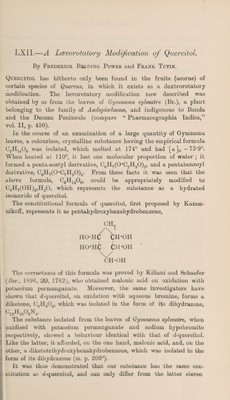
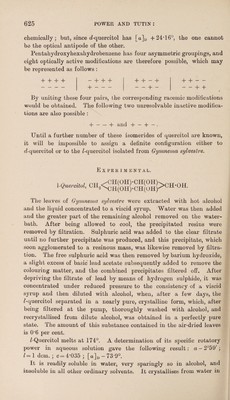
A laevo-rotatory modification of quercitol / by Frederick B. Power and Frank Tutin.
- Frederick Belding Power
- Date:
- [1904.]
Licence: In copyright
Credit: A laevo-rotatory modification of quercitol / by Frederick B. Power and Frank Tutin. Source: Wellcome Collection.
6/12 page 627
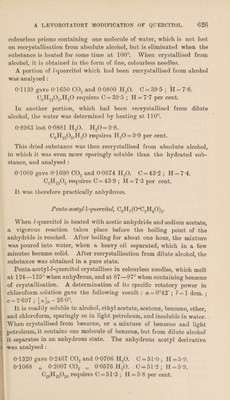
![An attempt was made to determine the molecular weight of Z-quercitol in phenol solution, but it was not sufficiently soluble. The acetyl derivative was therefore selected for this purpose, and its mole¬ cular weight was determined by the cryoscopic method in benzene solution. 0*4288 in 24*38 benzene gave At - 0*248°. M. W. = 348. Ci6H22O10 requires M. W. = 374. The number of acetyl groups in this compound was determined by hydrolysing a weighed quantity of the substance with a known volume of standard alcoholic solution of sodium hydroxide and titrating the excess of alkali with standard acid. The percentage of acetyl found by this means was 80*3, the theoretical percentage for five acetyl groups being 78*9. It was observed that the penta-acetyl-Z-quercitol which had been crystallised from benzene melted at 87—97°, but after heating to 80° for a short time melted at 124—125°, which is the melting point of the anhydrous substance. The whole of the benzene was also given off in the course of two or three days at the ordinary tempera¬ ture. A portion of the acetyl derivative was crystallised from benzene, pressed on a porous tile until free from adhering solvent, and the amount of benzene of crystallisation determined by heating at 100° until the weight of the residue remained constant. 0*5200 lost 0*0880 C6H6. C6H6=16*9. 0*7142 „ 0*1239 C6H6. C6H6=17*3. Ci6H22Oio,C6H6 requires C6Hfi= 17*3 per cent. PentabenzoylA-quercitol, CgH^O’C^HgO)^ The Z-quercitol was benzoylated by the Schotten-Baumann method, and also by heating it with an excess of benzoyl chloride until hydrogen chloride ceased to be evolved ; the products obtained were identical. Pentabenzoyl-£-quercitol shows the same behaviour towards solvents as the acetyl derivative; it separates from alcohol in an amorphous state, melts at 133°, and is anhydrous. A determination of its specific rotatory power in chloroform solution gave the following result: a - 2°14' \ l =1 dcm.; c = 2*826 ; [a]D -79*0°. On adding a quantity of light petroleum to a solution of the substance in a mixture of warm ethyl acetate and alcohol, needle-shaped crystals containing one molecule of alcohol slowly separated. These crystals, when dried in the air, melt at 116°, but the melting point is raised to](https://iiif.wellcomecollection.org/image/b30606573_0006.jp2/full/800%2C/0/default.jpg)