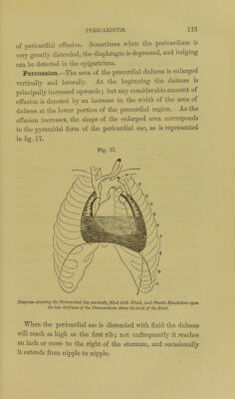
Licence: Public Domain Mark
Credit: Lessons in physical diagnosis / by Alfred L. Loomis. Source: Wellcome Collection.
Provider: This material has been provided by the Royal College of Physicians of Edinburgh. The original may be consulted at the Royal College of Physicians of Edinburgh.
115/250 (page 109)
![tends as high as the fifth vertebra, the murmnr is heard above that point, because here the aorta approaches the sur- face. Aortic Begurgitant Diastolic. « The intensity of the murmur from valve to right of apex may or may not increase downwards, depending on the prox- imity of heart to parietes, the position of lungs, etc.; it may decrease downwards, however, from emphysema, supine re- cumbency, etc., or may perchance be loudest at apex; de- pending on proximity of heart to the parietes, position of the parts, condition of the mitral valve, etc. Generally it is not heard behind, but ma]], towards inner side of lower angle of scapula, in thin subjects especially, be heard in the same place where is heard the non-mitral regurgi- tant ; this non-mitral regui-gitant being the mitral regurgi- tant of BeUingham and others. It is sometimes conveyed to left axiUa. The patient when recumbent may sometimes hear it him- self. Mitral Begurgitant Systolic. To indicate regurgitation, the murmur must be heard be- tween lower border of fifth, and upper border of eighth ver- tebra at left of spine, provided the transmission of the sound be not interfered with by thickness of integuments, or other conditions of the parts. When not heard ia this place, but in left axilla and in the region of the left scapula, regurgitation is not indicated ; or, in other words, it is a non-regurgitant murmur, contrary to the teaching of BeUingham and others. '' If there be a systohc murmur with a maximum of intensity between fifth and eighth vertebrte, at left of spine, it indicates regurgitation.](https://iiif.wellcomecollection.org/image/b21928046_0115.jp2/full/800%2C/0/default.jpg)