Tables of physical and chemical constants and some mathematical functions / by G.W.C. Kaye and T.H. Laby.
- G. W. C. Kaye
- Date:
- [1941]
Licence: Public Domain Mark
Credit: Tables of physical and chemical constants and some mathematical functions / by G.W.C. Kaye and T.H. Laby. Source: Wellcome Collection.
23/200 (page 11)
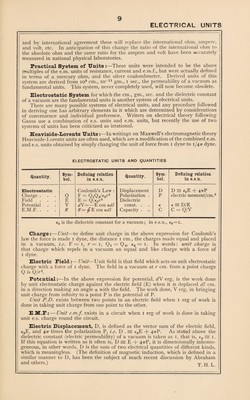
![ELECTRICAL UNITS the cavity having plane sides normal to the direction of the magnetization. This definition and the preceding one have been the subject of much discussion. (See “ References ” above, particularly Abraham’s paper.) Intensity of Magnetization, I, of a magnetic material is its magnetic moment per unit volume. It is evidently the magnetic pole per cm.2 over a plane surface normal to the direction of polarization. Magnetic Permeability, /x. Although the magnetic induction B induced by a magnetizing force H is not proportional to H, for materials which show magnetic hysteresis, magnetic permeability, /x, is defined by the relation /x = B/H. Magnetic Susceptibility, k. I/H is constant for diamagnetic and some paramagnetic materials, k is defined by the relation k ~ I/H. Since I = (B — ^0H)/47t, and /x0 = i in e.m.u., therefore k — (/x — i)/4tt. Magnetic Flux:—The magnetic flux for an element of area dS cm. is B.^/S. The flux cb for a surface S cm.2 is B^/S, the quantities being vector ones. U Electrical Units:—Units of all the magnetic quantities have been derived from Coulomb’s law of force and four fundamental units. To pass from magnetic to electrical units Ampere’s law for the magnetic field of an electric current is used to define unit current in terms of unit magnetic pole. Electromagnetic Unit Current flows in a conductor when the work done in taking unit magnetic pole in a closed path round the conductor is 477 erg. Electric Charge:—Unit quantity of electricity crosses in 1 sec. any section of a conductor when I e.m.u. of current flows in the conductor. Electromagnetic Units of the following quantities are derived from the e.m.u. of charge by means of the expressions given in the above table under electrical quantities : Potential, E.M.F., Capacity, Resistance, Inductance. The defining relations for Displacement, Polarization, and Dielectric Constant given in the Table of Electrostatic Units are used to derive units of these quantities from the e.m.u. of charge. Conversion Factors :—The ratio of the electromagnetic units to the electro¬ static units, and to the practical absolute units is given on p. 12. Inductance is defined by Faraday’s law, = — dN/dt — — Ldl/dt, for the e.m.f. induced in a circuit when the current in it varies. The Mutual Inductance, M, of a pair of coils is given in terms of their linear dimensions by Neumann’s formula M == /xff cos adl. dl'jr, which is derived from Ampere’s law. Both laws give the same e.m. unit of inductance sometimes called the “ centimetre.” L and M have the dimensions —[/x . length]. PRACTICAL ELECTRICAL UNITS The International Ohm is the resistance offered to an unvarying electric current by a column of mercury at o° C., 14-4521 grammes in mass, of a constant cross-section, and of a length of 106-300 cms. The International Ampere is the unvarying electric current which, when passed through a solution of nitrate of silver in water, in accordance with authorized specification, deposits silver at the rate of -ooi 11800 gramme per second. DIMENSIONS OF ELECTRICAL QUANTITIES Dimensions ofE.S. Units:—The dimensions of electric charge in terms of M, L, T and e are derived from Coulomb’s law thus : [F] = [M LT~2] = [QiQ2/eL2], giving [Q] = [M‘lU-M] t H L.](https://iiif.wellcomecollection.org/image/b31356904_0023.jp2/full/800%2C/0/default.jpg)