A treatise on food and diet : with observations on the dietetical regimen suited for disordered states of the digestive organs : and an account of the dietaries of some of the principal metropolitan and other establishments for paupers, lunatics, criminals, children, the sick, &c / by Jonathan Pereira ; edited by Charles A. Lee.
- Jonathan Pereira
- Date:
- 1843
Licence: Public Domain Mark
Credit: A treatise on food and diet : with observations on the dietetical regimen suited for disordered states of the digestive organs : and an account of the dietaries of some of the principal metropolitan and other establishments for paupers, lunatics, criminals, children, the sick, &c / by Jonathan Pereira ; edited by Charles A. Lee. Source: Wellcome Collection.
Provider: This material has been provided by the National Library of Medicine (U.S.), through the Medical Heritage Library. The original may be consulted at the National Library of Medicine (U.S.)
35/350
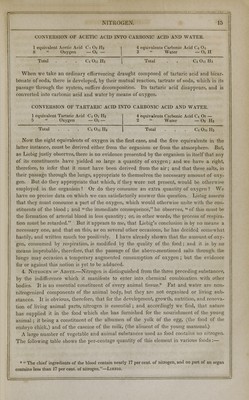
![CONVERSION OF ACETIC ACID INTO CARBONIC ACID AND WATER. 1 equivalent Acetic Acid Ci O3 IT3 1 4 equivalents Carbonic Acid C4 Os 8 Oxygen — Og — 3 Water — Oa H Total C4 On H3 1 Total . . C4 On H3 When we take an ordinary effervescing draught composed of tartaric acid and bicar- bonate of soda, there is developed, by their mutual reaction, tartrate of soda, which in its passage through the system, suffers decomposition. Its tartaric acid disappears, and is converted into carbonic acid and water by means of oxygen. CONVERSION OF TARTARIC ACID INTO CARBONIC ACID AND WATER. 1 equivalent Tartaric Acid C4 O5 H2 5 Oxygen — Os — 4 equivalents Carbonic Acid C4 Os — 2 Water — Os H2 Total . . . C4 O10 Ha Total . . . C4O10H2 Now the eight equivalents of oxygen in the first case, and the five equivalents in the latter instance, must be derived either from the organism or from the atmosphere. But, as Liebig justly observes, there is no evidence presented by the organism in itself that any of its constituents have yielded so large a quantity of oxygen; and we have a right, therefore, to infer that it must have been derived from the air; and that these salts, in their passage through the lungs, appropriate to themselves the necessary amount of oxy- gen. But do they appropriate that which, if they were not present, would be otherwise employed in the organism 1 Or do they consume an extra quantity of oxygen ] We have no precise data on which we can satisfactorily answer this question. Liebig asserts that they must consume a part of the oxygen, which would otherwise unite with the con- stituents of the blood ; and the immediate consequence, he observes, of this must be the formation of arterial blood in less quantity; or, in other words, the process of respira- tion must be retarded. But it appears to me, that Liebig's conclusion is by no means a necessary one, and that on this, as on several other occasions, he has decided somewhat hastily, and written much too positively. I have already shown that the amount of oxy- gen, consumed by respiration, is modified by the quality of the food; and it is by no means improbable, therefore, that the passage of the above-mentioned salts through the lungs may occasion a temporary augmented consumption of oxygen ; but the evidence for or against this notion is yet to be adduced. 4. Nitrogen or Azote.—Nitrogen is distinguished from the three preceding substances, by the indifference which it manifests to enter into chemical combination with other bodies. It is an essential constituent of every animal tissue.* Fat and water are non- nitrogenized components of the animal body, but they are not organized or living sub- stances. It is obvious, therefore, that for the development, growth, nutrition, and renova- tion of living animal parts, nitrogen is essential; and accordingly we find, that nature has supplied it in the food which she has furnished for the nourishment of the young animal; it being a constituent of the albumen of the yolk of the egg, (the food of the embryo chick,) and of the caseine of the milk, (the aliment of the young mammal.) A large number of vegetable and animal substances used as food contains no nitrogen. The following table shows the per-centage quantity of this element in various foods:— * The chief ingredients of the blood contain nearly 17 per cent, of nitrogen, and no part of an organ contains less than 17 per cent, of nitrogen.—Liebig.](https://iiif.wellcomecollection.org/image/b21146792_0035.jp2/full/800%2C/0/default.jpg)