A treatise on food and diet : with observations on the dietetical regimen suited for disordered states of the digestive organs : and an account of the dietaries of some of the principal metropolitan and other establishments for paupers, lunatics, criminals, children, the sick, &c / by Jonathan Pereira ; edited by Charles A. Lee.
- Jonathan Pereira
- Date:
- 1843
Licence: Public Domain Mark
Credit: A treatise on food and diet : with observations on the dietetical regimen suited for disordered states of the digestive organs : and an account of the dietaries of some of the principal metropolitan and other establishments for paupers, lunatics, criminals, children, the sick, &c / by Jonathan Pereira ; edited by Charles A. Lee. Source: Wellcome Collection.
Provider: This material has been provided by the National Library of Medicine (U.S.), through the Medical Heritage Library. The original may be consulted at the National Library of Medicine (U.S.)
43/350
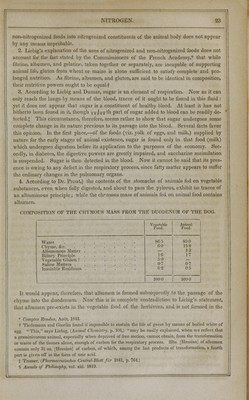
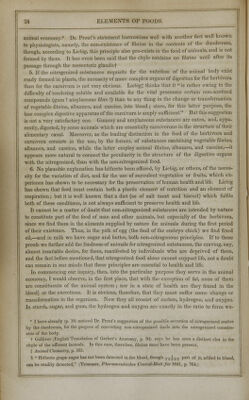
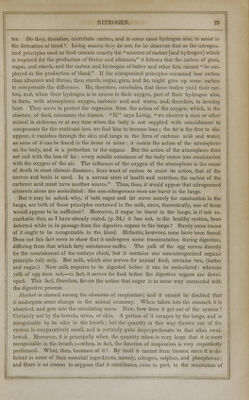
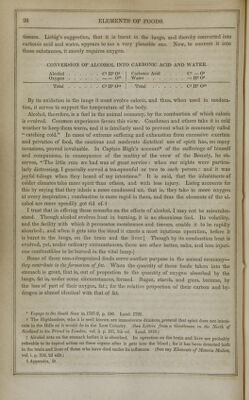
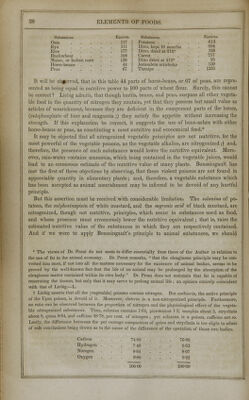
![non-nitrogenized foods into nitrogenized constituents of the animal body does not appear by any means improbable. 2. Liebig's explanation of the uses of nitrogenized and non-nitrogenized foods does not account for the fact stated by the Commissioners of the French Academy,* that while fibrine, albumen, and gelatine, taken together or separately, are incapable of supporting animal life, gluten from wheat or maize is alone sufficient to satisfy complete and pro- longed nutrition. As fibrine, albumen, and gluten, are said to be identical in composition, their nutritive powers ought to be equal.f 3. According to Liebig and Dumas, sugar is an element of respiration. Now as it can only reach the lungs by means of the blood, traces of it ought to be found in this fluid : yet it does not appear that sugar is a constituent of healthy blood. At least it has not hitherto been found in it, though Tooorth part of sugar added to blood can be readily de- tected.;!; This circumstance, therefore, seems rather to show that sugar undergoes some complete change in its nature previous to its passage into the blood. Several facts favor this opinion. In the first place,—of the foods (viz. yolk of eggs, and milk,) supplied by nature for the early stages of animal existence, sugar is found only in that food (milk) which undergoes digestion before its application to the purposes of the economy. Sec- ondly, in diabetes, the digestive powers are greatly impaired, and saccharine assimilation is suspended. Sugar is then detected in the blood. Now it cannot be said that its pres- ence is owing to any defect in the respiratory process, since fatty matter appears to suffer the ordinary changes in the pulmonary organs. 4. According to Dr. Prout,$ the contents of the stomachs of animals fed on vegetable substances, even when fully digested, and about to pass the pylorus, exhibit no traces of an albuminous principle ; while the ch^mous mass of animals fed on animal food contains albumen. COMPOSITION OF THE CHYMOUS MASS FROM THE DUODENUM OF THE DOG. Water Chyme, &c. Albuminous Matter Biliary Principle Vegetable Gluten ? Saline Matters . Insoluble Residuum Vegetable 1' ood. Animal Food. 865 800 6-0 15-8 1-3 1-6 1-7 5-0 _ 0-7 0-7 02 0-5 1000 100-0 It would appear, therefore, that albumen is formed subsequently to the passage of the chyme into the duodenum. Now this is in complete contradiction to Liebig's statement, that albumen pre-exists in the vegetable food of the herbivora, and is not formed in the * Compte.s Rendus, Aoiit, 1842. t Tiedemann and Gmelin found it impossible to sustain the life of geese by means of boiled white of egg. This,*' says Liebig, (Animal Chemistry, p. 106,) may be easily explained, when we reflect that a graminivorous animal, especially when deprived of free motion, cannot obtain, from the transformation or waste of the tissues alone, enough of carbon for the respiratory process. 21bs. [Hessian] of albumen contain only 3i oz. [Hessian] of carbon, of which, among the last products of transformation, a fourth part is given off in the form of uric acid. t Tromer, (Pharmaceutisches Central-BlaU fur 1841, p. 764.) $ Annals of Philosophy, vol. xiii. 1819.](https://iiif.wellcomecollection.org/image/b21146792_0043.jp2/full/800%2C/0/default.jpg)