A treatise on food and diet : with observations on the dietetical regimen suited for disordered states of the digestive organs : and an account of the dietaries of some of the principal metropolitan and other establishments for paupers, lunatics, criminals, children, the sick, &c / by Jonathan Pereira ; edited by Charles A. Lee.
- Jonathan Pereira
- Date:
- 1843
Licence: Public Domain Mark
Credit: A treatise on food and diet : with observations on the dietetical regimen suited for disordered states of the digestive organs : and an account of the dietaries of some of the principal metropolitan and other establishments for paupers, lunatics, criminals, children, the sick, &c / by Jonathan Pereira ; edited by Charles A. Lee. Source: Wellcome Collection.
Provider: This material has been provided by the National Library of Medicine (U.S.), through the Medical Heritage Library. The original may be consulted at the National Library of Medicine (U.S.)
45/350
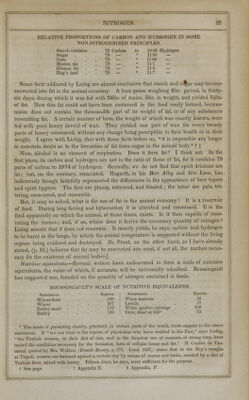
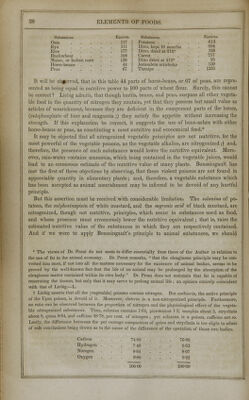
![ter. Do they, therefore, contribute carbon, and in some cases hydrogen also, to assist in the formation of blood) Liebig asserts they do not, for he observes that as the nitrogen- ized principles used as food contain exactly the amount of carbon [and hydrogen] which is required for the production of fibrine and albumen, it follows that the carbon of gum, sugar, and starch, and the carbon and hydrogen of butter and other fats, cannot be em- ployed in the production of blood. If the nitrogenized principles contained less carbon than albumen and fibrine, then starch, sugar, gum, and fat, might give up some carbon to compensate the difference. He, therefore, concludes, that these bodies yield their car- bon, and, when their hydrogen is in excess to their oxygen, part of their hydrogen also, to form, with atmospheric oxygen, carbonic acid and water, and, therefore, to develop heat. They serve to protect the organism from the action of the oxygen, which, in the absence of food, consumes the tissues. If, says Liebig, we observe a man or other animal in sickness, or at any time when the body is not supplied with nourishment to compensate for the continual loss, we find him to become lean; the fat is the first to dis- appear, it vanishes through the skin and lungs in the form of carbonic acid and water, as none of it can be found in the faeces or urine: it resists the action of the atmosphere on the body, and is a protection to the organs. But the action of the atmosphere does not end with the loss of fat: every soluble substance of the body enters into combination with the oxygen of the air. The influence of the oxygen of the atmosphere is the cause of death in most chronic diseases; from want of carbon to resist its action, that of the nerves and brain is used. In a normal state of health and nutrition, the carbon of the carbonic acid must have another source. Thus, then, it would appear that nitrogenized aliments alone are assimilated: the non-nitrogenous ones are burnt in the lungs. But it may be asked, why, if both sugar and fat serve merely for combustion in the lungs, are both of these principles contained in the milk, since, theoretically, one of them would appear to be sufficient ] Moreover, if sugar be burnt in the lungs, is it not re- markable that, as I have already stated, (p. 24,) it has not, in the healthy system, been detected while in its passage from the digestive organs to the lungs 1 Surely some traces of it ought to be recognizable in the blood. Hitherto, however, none have been found. Does not this fact seem to show that it undergoes some transmutation during digestion, differing from that which fatty substances suffer. The yolk of the egg serves directly for the nourishment of the embryo chick, but it contains one non-nitrogenized organic principle (oil) only. But milk, which also serves for animal food, contains two, (butter and sugar.) Now milk requires to be digested before it can be assimilated: whereas yolk of egg does not,—in fact, it serves for food before the digestive organs are devel- oped. This fact, therefore, favors the notion that sugar is in some way connected with the digestive process. Alcohol is classed among the elements of respiration; and it cannot be doubted that it undergoes some change in the animal economy. When taken into the stomach it is absorbed, and gets into the circulating mass. Now, how does it get out of the system ? Certainly not by the bowels, urine, or skin. A portion of it escapes by the lungs, and is recognizable by its odor in the breath; but the quantity in this way thrown out of the system is comparatively small, and is certainly quite disproportionate to that often swal- lowed. Moreover, it is principally when the quantity taken is very large that it is most recognizable in the breath ;—when, in fact, the function of respiration is very imperfectly performed. What, then, becomes of it 1 By itself it cannot form tissues, since it is de- ficient in some of their essential ingredients, namely, nitrogen, sulphur, and phosphorus; and there is no reason to suppose that it contributes, even in part, to the renovation of](https://iiif.wellcomecollection.org/image/b21146792_0045.jp2/full/800%2C/0/default.jpg)