A treatise on food and diet : with observations on the dietetical regimen suited for disordered states of the digestive organs : and an account of the dietaries of some of the principal metropolitan and other establishments for paupers, lunatics, criminals, children, the sick, &c / by Jonathan Pereira ; edited by Charles A. Lee.
- Jonathan Pereira
- Date:
- 1843
Licence: Public Domain Mark
Credit: A treatise on food and diet : with observations on the dietetical regimen suited for disordered states of the digestive organs : and an account of the dietaries of some of the principal metropolitan and other establishments for paupers, lunatics, criminals, children, the sick, &c / by Jonathan Pereira ; edited by Charles A. Lee. Source: Wellcome Collection.
Provider: This material has been provided by the National Library of Medicine (U.S.), through the Medical Heritage Library. The original may be consulted at the National Library of Medicine (U.S.)
47/350
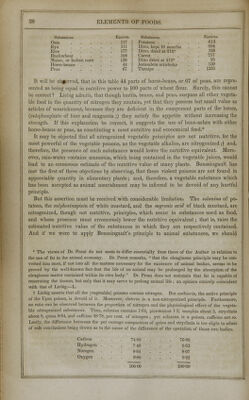
![RELATIVE PROPORTIONS OF CARBON AND HYDROGEN IN SOME NON-NITROGENIZED PRINCIPLES. Starch contains 79 Carbon to 10-99 Hydrogen Sugar 79 — 11-80 — Gum 79 — it 11-80 — Mutton fat 79 — 111 — Human fat 79 — 11-4 — Hog's lard 79 — U 11-7 — Some facts adduced by Liebig are almost conclusive that starch and su%ar may become converted into fat in the animal economy. A lean goose weighing 41bs. gained, in thirty- six days, during which it was fed with 241bs. of maize, 51bs. in weight, and yielded 3ilbs. of fat. Now this fat could not have been contained in the food ready formed, because maize does not contain the thousandth part of its weight of fat, or of any substances resembling fat. A certain number of bees, the weight of which was exactly known, were fed with pure honey devoid of wax. They yielded one part of wax for every twenty parts of honey consumed, without any change being perceptible in their health or in their weight. I agree with Liebig, that with these facts before us, it is impossible any longer to entertain doubt as to the formation of fat from sugar in the animal body.* f t Now, alcohol is an element of respiration. Does it form fat 1 I think not. In the first place, its carbon and hydrogen are not in the ratio of those of fat, for it contains 79 parts of carbon to 19-74 of hydrogen. Secondly, we do not find that spirit drinkers are fat; but, on the contrary, emaciated. Hogarth, in his Beer Alley and Gin Lane, has ludicrously though faithfully represented the differences in the appearance of beer topers and spirit tipplers. The first are plump, rubicund, and bloated ; the latter are pale, tot- tering, emaciated, and miserable. But, it may be asked, what is the use of fat in the animal economy ] It is a reservoir of food. During long fasting and hybernation it is absorbed and consumed. It is the food apparently on which the animal, at these times, exists. Is it then capable of reno- vating the tissues; and, if so, where does it derive the necessary quantity of nitrogen'! Liebig asserts that it does not renovate. It merely yields, he says, carbon and hydrogen to be burnt in the lungs, by which the animal temperature is supported without the living organs being oxidized and destroyed. Dr. Prout, on the other hand, as I have already stated, (p. 18,) believes that fat may be converted into most, if not all, the matters neces- sary for the existence of animal bodies.^ Nutritive equivalents.—Several writers have endeavored to form a scale of nutritive equivalents, the value of which, if accurate, will be universally admitted. Boussingault has suggested one, founded on the quantity of nitrogen contained in foods. BOUSSINGAULT'S SCALE OF NUTRITIVE EQUIVALENTS. Substances. Equivts. I Substances. Equivts. Wheat-flour .... 100 White haricots ... 56 Wheat 107 Lentils 57 Barley-meal . . • . 119 White garden cabbage . . 810 Barley .... 130 I Ditto, dried at 212° . . . S3 * The mode of promoting obesity, practised in certain parts of the world, lends support to the above statements. If we can trust to the reports of physicians who have resided in the East, says Liebig, the Turkish women, in their diet of rice, and in the frequent use of cnemata of strong soup, have united the conditions necessary for the formation both of cellular tissue and fat. M. Caullet de Vau- moral, quoted by Mrs. Walker, (Female Beauty, p. 171. Lond. 1837,) states that in the Bey's seraglio at Tripoli, women are fattened against a certain day by means of repose and baths, assisted by a diet of Turkish flour, mixed with honey. Fifteen days, he says, were sufficient for the purpose. t See page t Appendix E. § Appendix, F. Jl](https://iiif.wellcomecollection.org/image/b21146792_0047.jp2/full/800%2C/0/default.jpg)