A treatise on food and diet : with observations on the dietetical regimen suited for disordered states of the digestive organs : and an account of the dietaries of some of the principal metropolitan and other establishments for paupers, lunatics, criminals, children, the sick, &c / by Jonathan Pereira ; edited by Charles A. Lee.
- Jonathan Pereira
- Date:
- 1843
Licence: Public Domain Mark
Credit: A treatise on food and diet : with observations on the dietetical regimen suited for disordered states of the digestive organs : and an account of the dietaries of some of the principal metropolitan and other establishments for paupers, lunatics, criminals, children, the sick, &c / by Jonathan Pereira ; edited by Charles A. Lee. Source: Wellcome Collection.
Provider: This material has been provided by the National Library of Medicine (U.S.), through the Medical Heritage Library. The original may be consulted at the National Library of Medicine (U.S.)
48/350
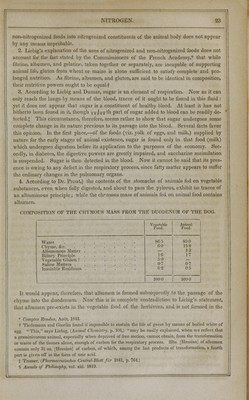
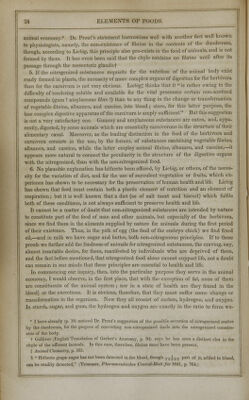
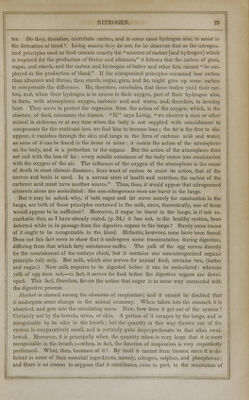
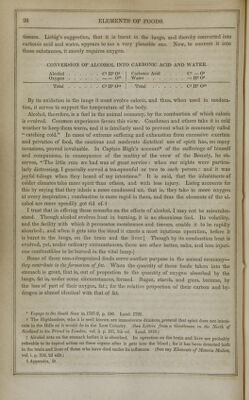
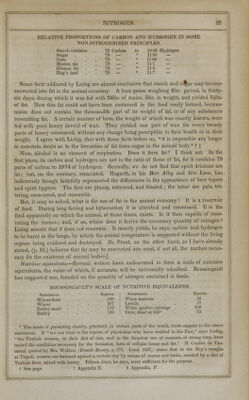
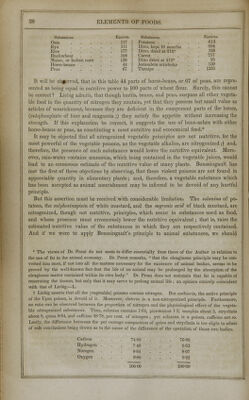
![Substances- Equivts. Substances. p(|irivls 117 Potatoes .... 613 Rye .... 111 Ditto, kept 10 months 894 Rice .... 177 Ditto, dried at 212° 126 Buckwheat 108 Carrot .... 757 Maize, or Indian corn 138 Ditto dried at 212° . 95 Horse-beans 44 Jerusalem artichoke 539 67 Turnips .... . 1335 It will be observed, that in this table 44 parts of horse-beans, or 67 of peas, are repre- sented as being equal in nutritive power to 100 parts of wheat flour. Surely, this cannot be correct ■? Liebig admits, that though lentils, beans, and peas, surpass all other vegeta- ble food in the quantity of nitrogen they contain, yet that they possess but small value as articles of nourishment, because they are deficient in the component parts of the bones, (subphosphate of lime and magnesia ;) they satisfy the appetite without increasing the strength. If this explanation be correct, it suggests the use of bone-ashes with either horse-beans or peas, as constituting a most nutritive and economical food.* It may be objected that all nitrogenized vegetable principles are not nutritive, for the most powerful of the vegetable poisons, as the vegetable alkalies, are nitrogenized ;f and, therefore, the presence of such substances would lower the nutritive equivalent. More- over, rain-water contains ammonia, which being contained in the vegetable juices, would lead to an erroneous estimate of the nutritive value of many plants. Boussingault has met the first of these objections by observing, that these violent poisons are not found in appreciable quantity in alimentary plants; and, therefore, a vegetable substance which has been accepted as animal nourishment may be inferred to be devoid of any hurtful principle. But this assertion must be received with considerable limitation. The solanina of po- tatoes, the sulphosinapisin of white mustard, and the myronic acid of black mustard, are nitrogenized, though not nutritive, principles, which occur in substances used as food, and whose presence must erroneously lower the nutritive equivalent; that is, raise the estimated nutritive value of the substances in which they are respectively contained. And if Ave were to apply Boussingault's principle to animal substances, we should * The views of Dr. Prout do not seem to differ essentially from those of the Author in relation to the use of fat in the animal economy. Dr. Prout remarks, that the oleaginous principle may be con- verted into most, if not into all the matters necessary for the existence of animal bodies, seems to be proved by the well-known fact that the life of an animal may be prolonged by the absorption of the oleaginous matter contained within its own body. Dr. Prout does not maintain that fat is capable of renovating the tissues, but only that it may serve to prolong animal life ; an opinion entirely coincident with that of Liebig.—L. t Liebig asserts that all the [vegetable] poisons contain nitrogen. But anthiarin, the active principle of the Upas poison, is devoid of it. Moreover, elalerin is a non-nitrogenized principle. Furthermore, no ratio can be observed between the proportion of nitrogen and the physiological effect of the vegeta- ble nitrogenized substances. Thus, solanina contains 1-64, picrotoxine 13, morphia about 5, strychnia about 8, quina 864, and caffeine 28-78, per cent, of nitrogen ; yet solanina is a poison, caffeine not so. Lastly, the difference between the per centage composition of quina and strychnia is too slight to admit of safe conclusions being drawn as to the cause of the difference of the operation of those two bodies. Carbon 74-08 Hydrogen . 7-40 Nitrogen 8-64 Oxygen 9-88 100 00 7608 663 807 9-22 10000](https://iiif.wellcomecollection.org/image/b21146792_0048.jp2/full/800%2C/0/default.jpg)