A treatise on food and diet : with observations on the dietetical regimen suited for disordered states of the digestive organs : and an account of the dietaries of some of the principal metropolitan and other establishments for paupers, lunatics, criminals, children, the sick, &c / by Jonathan Pereira ; edited by Charles A. Lee.
- Jonathan Pereira
- Date:
- 1843
Licence: Public Domain Mark
Credit: A treatise on food and diet : with observations on the dietetical regimen suited for disordered states of the digestive organs : and an account of the dietaries of some of the principal metropolitan and other establishments for paupers, lunatics, criminals, children, the sick, &c / by Jonathan Pereira ; edited by Charles A. Lee. Source: Wellcome Collection.
Provider: This material has been provided by the National Library of Medicine (U.S.), through the Medical Heritage Library. The original may be consulted at the National Library of Medicine (U.S.)
51/350
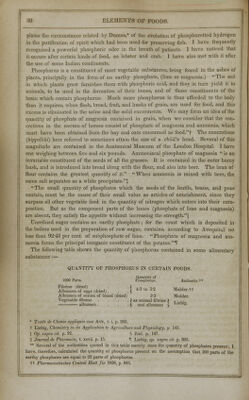
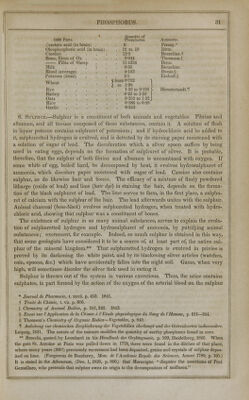
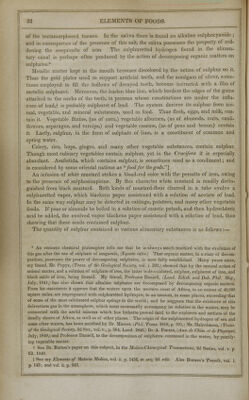
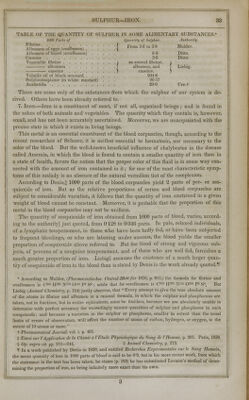
![Quantity of 1000 Parts. Phosphorus. Authority. Cerebric acid (in brain) . . 9 Fremy.* Oleophosphoric acid (in brain). . 12 to 19 Ditto. Caseine 132 Berzelius.t Bone, Ilium of Ox . . . . 9-944 Thomson.* Fibia of Sheep . . . 114334 Ditto. Milk ...).. 0-56 Berzelius. Blood (average) . . . .0-143 Denis.§ Potatoes (dried) .... 2-5 Einhoff.H Wbe« j*-tJ? ] Rye 1-32 to 9196 i Hermbstaedt.T Barley 022 to 1-32 Oats 0-352 to 1-32 J Rice 0-286 to 0-83 Garlic 0-242 0. Sulphur.—Sulphur is a constituent of both animals and vegetables. Fibrine and albumen, and all tissues composed of these substances, contain it. A solution of flesh in liquor potassae contains sulphuret of potassium; and if hydrochloric acid be added to it, sulphuretted hydrogen is evolved, and is detected by its staining paper moistened with a solution of sugar of lead. The discoloration which a silver spoon suffers by being used in eating eggs, depends on the formation of sulphuret of silver. It is probable, therefore, that the sulphur of both fibrine and albumen is uncombined with oxygen. If some white of egg, boiled hard, be decomposed by heat, it evolves hydrosulphuret of ammonia, which discolors paper moistened with sugar of lead. Caseine also contains sulphur, as do likewise hair and bones. The efficacy of a mixture of finely powdered litharge (oxide of lead) and lime {hair dye) in staining the hair, depends on the forma- tion of the black sulphuret of lead. The lime serves to form, in the first place, a sulphu- ret of calcium with the sulphur of the hair. The lead afterwards unites with the sulphur. Animal charcoal (bone-black) evolves sulphuretted hydrogen, when treated with hydro- chloric acid, showing that sulphur was a constituent of bones. The existence of sulphur in so many animal substances, serves to explain the evolu- tion of sulphuretted hydrogen and hydrosulphuret of ammonia, by putrifying animal substances; excrement, for example. Indeed, so much sulphur is obtained in this way, that some geologists have considered it to be a source of, at least part of, the native sul- phur of the mineral kingdom.** That sulphuretted hydrogen is evolved in privies is proved by its darkening the white paint, and by its blackening silver articles (watches, coin, spoons, &c.) which have accidentally fallen into the night soil. Game, when very high, will sometimes discolor the silver fork used in eating it. Sulphur is thrown out of the system in various excretions. Thus, the urine contains sulphates, in part formed by the action of the oxygen of the arterial blood on the sulphur * Journal de Pharmacie, t. xxvii. p. 453. 1841. t Trade de Chimie, t. vii. p. 606. t Chemistry of Animal Bodies, p. 241,242. 1843. $ Essai sur VApplication de la Chimie a VElude physiologique du Sang de VHomme, p. 211—244. il Thomson's Chemistry of Organic Bodies—Vegetables, p. 840. IT Anleitung zur chemischen Zergliederung der Vegetdbilien uberhaupt und der Getrcidearten insbesondere. Leipzig, 1831. The nature of the manure modifies the quantity of earthy phosphates found in corn. ** Brocchi, quoted by Leonhard in his Handbuch der Oryktognosie, p. 599, Heidelberg, 1826. When the gate St. Antoine at Paris was pulled down in 1778, there were found in the ditches of that place, where many years (300?) previously excrement had been deposited, grains and crystals of sulphur depos- ited on lime. (Fougcroux de Bondarey, Mem. de I'Academie Royalc des Sciences, Annee 1780, p. 105.) It is stated in the Athenceum, (Dec. 1, 1833, p. 860,) that Maravigno disputes the assertions of Prof. Gemellaro, who pretends that sulphur owes its origin to the decomposition of mollusca.](https://iiif.wellcomecollection.org/image/b21146792_0051.jp2/full/800%2C/0/default.jpg)