A treatise on food and diet : with observations on the dietetical regimen suited for disordered states of the digestive organs : and an account of the dietaries of some of the principal metropolitan and other establishments for paupers, lunatics, criminals, children, the sick, &c / by Jonathan Pereira ; edited by Charles A. Lee.
- Jonathan Pereira
- Date:
- 1843
Licence: Public Domain Mark
Credit: A treatise on food and diet : with observations on the dietetical regimen suited for disordered states of the digestive organs : and an account of the dietaries of some of the principal metropolitan and other establishments for paupers, lunatics, criminals, children, the sick, &c / by Jonathan Pereira ; edited by Charles A. Lee. Source: Wellcome Collection.
Provider: This material has been provided by the National Library of Medicine (U.S.), through the Medical Heritage Library. The original may be consulted at the National Library of Medicine (U.S.)
56/350
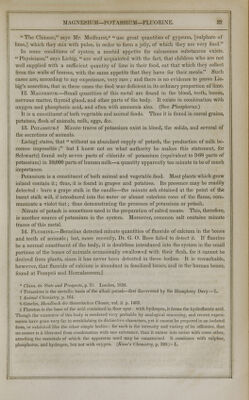
![Sodium.—Sodium is a constituent of the blood, the animal tissues, and the secretions. Owing to its presence, the ashes of animal substances (feathers, bristles, hairs, flesh, &c.) possess the property of communicating a yellow tinge to flame. This metal is taken into the system, principally in the form of chloride, which contains 40 per cent, of the metal. This salt is used at our table as a condiment, and is a constit- uent of most animal foods. Thus it is contained in both the white and the yolk of egg, in milk, and in flesh. It is not an ordinary constituent of plants, unless they grow in the neighborhood of the sea or other salt water. Minute quantities of it are found in most of our common waters. Sodium is expelled from the system both in the form of chloride and of oxysalt. In the luine of flesh-eating animals it exists in the form of sulphate and phosphate of soda.* 11. Calcium.—This metal is a component part of all animals. In the higher classes it exists principally in the form of subphosphate of lime. Thus, the bones of the vertebrata contain this salt mixed with a small portion of carbonate of lime. But the shells and crusts of invertebrated animals, as lobsters, oysters, &c, consist of carbonate principally, but mixed with a little subphosphate of lime. Muscles, nervous matter, the liver, the thyroid gland, and, indeed, all the animal solids, as well as the blood, contain calcium in the form of subphosphate of lime. Calcium is a constituent of the white, the yolk, and the shell of eggs ; and it is probable that the calcium found in the skeleton of the chick, when it quits the shell, was derived from one or more of these sources-! It is likewise a constituent of milk, and from this source the young mammal derives the requisite subphosphate of lime for deposition in his bones. We derive the calcium of our system from the animal, vegetable, and mineral sub- stances which we consume as food. Thus bones, flesh, viscera, blood, and milk of animals, yield us this metal. To these sources must be added eggs, as above mentioned. Most vegetables also contain it. Thus subphosphate of lime is found in cereal grains, onions, and garlic ; the oxalate exists in the stalks of garden rhubarb used for making tarts and puddings ; the tartrate is found in grapes; gum and unrefined sugar yield ashes contain- ing calcium. Another source of calcium is common water, (well and river water,) which usually contains both bicarbonate and sulphate of lime. scarcely explicable on the hypothesis that its activity depends on a principle in a state of decomposition. I find that while acidulated infusions of the second stomach of the calf, and of the bladder soon become putrid and fetid, that of the fourth stomach remains remarkably free from unpleasant smell for several weeks. Lastly, I find, contrary to Liebig's statement, that a digestive liquor can be prepared from the fresh undried fourth stomach of a calf. I cannot agree with Liebig, that digestion is a process analogous to fermentation ; that in fact it is nothing more than the transformation of food, effected by the contact of matter in a state of decomposition If it were, a small quantity of gastric juice ought to be capable of effecting the digestion of an unlimited quantity of food. Now, the experiments of Dr. Beaumont on the natural gastric juice, and of Schwann on the artificial digestive liquor, prove that this is not the case. Both found that only a certain amount of food could be digested with a given quantity of gastric juice : and Dr. Beaumont observes, that when the juice becomes saturated, it refuses to dissolve more ; and if an excess of food have been taken the residue remains in the stomach, or passes into the bowels in a crude state. Now, this fact is quite in- consistent with the fermentation theory. * Appendix, G. t This, however, is denied by Dr. Prout, (Phil. Trims. 1322, p. 399.) I think I can venture to assert says he, after the most patient and attentive investigation, that it [the lime of the skeleton of the chick] does not pre-exist in the recent e^j ; certainly not, at least in any known state. The only possible sources therefore, whence it can be derived, are from the shell, or transmutation from other principles. I have before (p. 3) noticed Dr. Prout's opinions as to the origin of the lime of the chick when it leaves the shell](https://iiif.wellcomecollection.org/image/b21146792_0056.jp2/full/800%2C/0/default.jpg)