Report of the Commitee appointed by the Lords Commissioners of the Admiralty, to enquire into the causes of the outbreak of scurvy in the recent Arctic Expedition ; the adequacy of the provision made by the Admiralty in the way of food, medicine, and medical comforts ; and the propriety of the orders given by the commander o[f] the Expedition for provisioning the sledge parties.
- Great Britain. Admiralty. Committee on Scurvy.
- Date:
- [1877?]
Licence: Public Domain Mark
Credit: Report of the Commitee appointed by the Lords Commissioners of the Admiralty, to enquire into the causes of the outbreak of scurvy in the recent Arctic Expedition ; the adequacy of the provision made by the Admiralty in the way of food, medicine, and medical comforts ; and the propriety of the orders given by the commander o[f] the Expedition for provisioning the sledge parties. Source: Wellcome Collection.
Provider: This material has been provided by London School of Hygiene & Tropical Medicine Library & Archives Service. The original may be consulted at London School of Hygiene & Tropical Medicine Library & Archives Service.
24/570 page 22
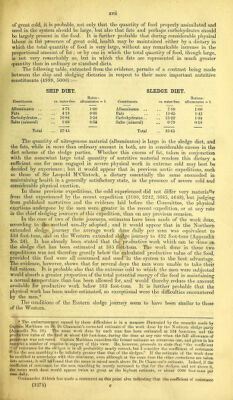
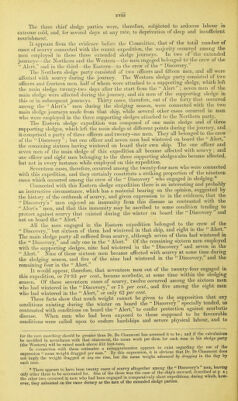
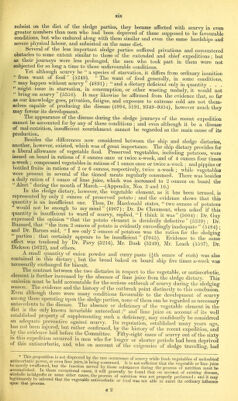
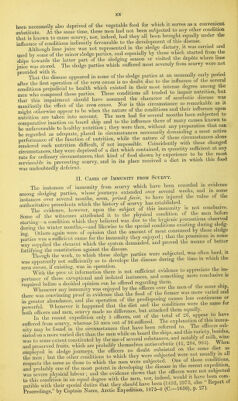
![preservative substances, eggs may be kept perfectly for many months without increasing their bulk in package. In arctic service, the difficulty of preservation would be only slight, as in a short time the eggs would be conveyed to a cold climate, in which the further use of any preservative substance would be unnecessary. The chief inconvenience resulting from milk of lime is that it makes the shells extremely brittle ; but if this inconvenience be a serious objection, it may be avoided by the use of oil, or butter, or collodion dissolved in ether, in place of milk of lime, or by preserving the eggs by merely dipping them for a few seconds in boiling water, or by pouring boiling vinegar over hard boiled eggs after the shells have been removed (4198). Milk, also, on account of its well known nutritive value, might be more largely used as an ordinary ration, in the form of condensed milk (655, 2102, 2432, 2710, 4253, 5194, 5477, 5718). It frequently constitutes the sole article of food during many months,* without scurvy appearing, and hence it has acquired a reputation as an antiscorbutic (5249, 7077 ), which, however, is not altogether beyond suspicion t (5162). It is quite obvious from the evidence and from the well-known nutritive value of fresh meat—a value which renders it specially adapted as a food for cold climates, apart from any influence it may be able to exert in warding off scorbutic disease—that it should form as large a proportion as possible of the meat diet. The application of this principle, however, is unfortunately beyond control, for it is limited by the circumstance that a sufficient supply is not always attainable owing to the scarcity of animal life in northern latitudes. In future expeditions, the supply may possibly be made independent of this circumstance, by fresh meat being carried in sufficient quantity, and preserved untainted until winter quarters are reached, by some method similar to that which within the last few months has been so successfully adopted in this country and in America.! Preserved and tinned meats may, however, be obtained of excellent quality. They are capable to a great extent of taking the place of fresh meat in dietaries well provided with vegetable substances. The chief objection that can certainly be urged against their use is that they are somewhat insipid, and on that account likely to become distasteful; but this objection may be greatly obviated by the plan adopted in the recent expedition of alternating the use of the several kinds as far as possible, and so obtaining variety, and of rendering them more palatable by the use of pickles and condiments. With the same object, salt meat may occasionally be used, care being taken that it is not oversalted, for in that case an unnecessarily large portion of the constituents soluble in water is removed with the brine and the water used in repeated soakings. At the same time the evidence seems to show that a prejudice exists with sailors against the use of salt meat (7204, 7888, 8189, 8190, 8382, 9303). An explanation of this prejudice may probably be found in the dread still lingering in their minds that, apart from any question of its nutritiousness, salt meat is peculiarly a cause of scurvy (7680, .8461). Cheese, butter, and oatmeal would all prove valuable additions, and may with advantage be taken into consideration in the framing of any future scheme of diet. However well adapted a dietary may be to supply sufficient nourishment, it cannot be regarded as a satisfactory one unless vegetable food be largely represented in it The functions of nutrition otherwise become perverted, and scorbutic disease manifests itself. It is impossible to attach too great importance to this point. The vegetables should as far as possible be of a succulent character, and, if preserved, but little changed in chemical composition. Tinned vegetables, such as were used on board the ships of the recent expedition, seem to be efficient representatives of fresh vegetables, as their chemical composition is essentially the same after as before preservation.^ Compressed vegetables, however, are not so trustworthy, IT and they should not constitute the main representatives of this class of food in the form in which they are now met with, although their occasional use may be attended with the advantage undoubtedlv derivable from variety. Among vegetable foods, the potato at present occupies the highest place as a valuable component of dietaries. It affords much nutriment, and, further, it tends so to influence, the process of nutrition that the special impairment of that process which renders itself obvious in the production of scorbutic symptoms is prevented, provided a sufficient, but by no means large, quantity be taken. The chemical examination of the preserved potato used in the recent expedition (Edwards's) shows that it retains all the chief * In Oaille's Account of a Residence among some African Tribes, the natives are represented as sub- sisting almost altogether vpon milk. t Dr. Partes. The British and Foreign Medico-Chirurgical Review, October, 1848, p. 442. '% Sheep were taken from England in H.M.S. Assistance (Austin's Expedition, ]850-51), and were killed when the ship reached a high latitude. The mutton was wrapped in matting and hung in the riggino- and it kept well for fourteen months; but it was necessary to thaw it gradually before cooking, as otherwise it became tainted. § Dr. Attfield's Report, p. xlvi. % Ditto, p. xlix.](https://iiif.wellcomecollection.org/image/b24397945_0024.jp2/full/800%2C/0/default.jpg)