Report of the Commitee appointed by the Lords Commissioners of the Admiralty, to enquire into the causes of the outbreak of scurvy in the recent Arctic Expedition ; the adequacy of the provision made by the Admiralty in the way of food, medicine, and medical comforts ; and the propriety of the orders given by the commander o[f] the Expedition for provisioning the sledge parties.
- Great Britain. Admiralty. Committee on Scurvy.
- Date:
- [1877?]
Licence: Public Domain Mark
Credit: Report of the Commitee appointed by the Lords Commissioners of the Admiralty, to enquire into the causes of the outbreak of scurvy in the recent Arctic Expedition ; the adequacy of the provision made by the Admiralty in the way of food, medicine, and medical comforts ; and the propriety of the orders given by the commander o[f] the Expedition for provisioning the sledge parties. Source: Wellcome Collection.
Provider: This material has been provided by London School of Hygiene & Tropical Medicine Library & Archives Service. The original may be consulted at London School of Hygiene & Tropical Medicine Library & Archives Service.
48/570 page 6
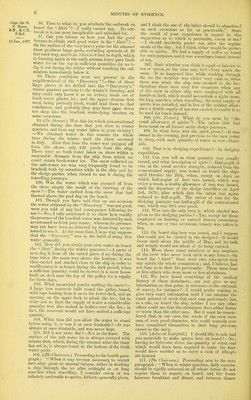
![MINUTES OF EVIDENCE. Capt. Sir G-. 96. Then to what do you attribute'the outbreak on EN KGB board.the Alert?—1 really cannot say. Its out- F.E.S. ' break 1S to me m°st inexplicable and unlooked for. 97. Can you inform us how you had the good 10 Jan., 1877. fortune to obtain such good water in the Alert? ■ On the surface of the very heavy polar ice the summer thaw produces large pools, extending upwards of 20 feet each way, and from 3 feet to 6 feet in depth, which in freezing again in the early autumn leave pure fresh water ice on the top in sufficient quantities for us to dig it out during the winter without touching the sail stratum immediately below it. 98. These conditions were not present in the neighbourhood of the Discovery ?— One of these large pieces of ice drifted into the Discovery's winter quarters previous to the winter's freezing, and they could only know it as an iceberg made out of fresh water glacier ice; and the upper stratum first used, being perfectly fresh, would lead them to that conclusion,- and probably they may have gene down too deep into the brackish under-lying stratum on some occasions. 99. (Dr. Bonnet.) Was this ice which you mentioned obtained during the time that you were in winter quarters, and from any water lakes in your vicinity ? —We obtained water in this manner the whole time during the winter until the thaw occurred in July. After that time the water was pumped off from the shore, only 120 yards from the ship. There were no fresh water lakes on shore within a reasonable distance from the ship from which we could obtain fresh-water ice. The' snow collected on the salt-water ice -was very frequently found to be brackish both by ourselves while in the ship and by the sledge parties when forced to use it during the travelling journeys. 100. Was the water which was pumped off from the shore simply the result of the thawing of the snow?—The water melted from the snow that had thawed above the pool dug on the beach. 101. Though you have said that on one occasion the water obtained by the Discovery was not good, were you told of any bad consequence following its' use?—No ; I only mentioned it to show'how readily the presence of the brackish water was detected by men accustomed to drink pure water; whereas its presence may not have been so detected by those long accus- tomed to use it. At the same time, I in no way suppose that the Discovery was in the habit of using this water generally. 102. How did you obtain your own water on board the Alert during the winter quarters?—A party of men dug it from off the raised piece of ice during the time when the moon was above the horizon; it was then carried and stacked close to the ship in order to readily carry it on board during, the dark period, when a sufficient quantity could be stowed in a snow house built on deck near the top of the galley for a supply for three clays. 103. What means had you for melting the snow? A large iron reservoir built round the galley funnel, with taps leading from it on to the lower deck, and an opening on the upper deck to admit the ice ; but in order not to limit the supply of water a considerable quantity was also melted in boilers over the fire; in fact, the reservoir would not have melted a sufficient quantity. 104. What time did you allow the water to stand before using it, or was it at once drinkable It was always at once drinkable, and was never kept. 105. Did it not taste flat?—Not in the least. The surface of the salt water ice is always covered with minute dust, which, during the summer after the thaw has set in, is always found at the bottom of the fresh water pools. ] 06. (The Chairman.) Proceeding to the fourth para- graph : When it may become necessary to recruit men after great or unusual fatigue, either in working a ship through the ice after midnight or on long marches when travelling, I consider cocoa or tea infinitely preferable to spirits, hitherto generally given, and I think the use of the latter should be abandoned on such occasions as far as practicable. State the result of your experience in regard to this suggestion as to which is preferable, cocoa or tea? —I should decidedly prefer tea after the regular meals of the day ; but I think either would be prefer- able to spirits. We had a supply of coffee on board for such purposes, and it was sometimes issued instead of tea. 107. State Avhether you think it equal or inferior to tea or cocoa, as the case may be ?—Very much the same. It so happened that while working through the ice the weather was either very calm or, when there was wind, the ship was secured to the ice; therefore there were very few occasions when any of the crew in either ship were employed with all hands on deck, which would necessitate a night issue. On long marches, Avhen travelling, the usual supply of . spirits was curtailed, and in lieu of the midday allow- ance a double supply of tea was carried, to enable it to be used for lunch instead. 108. (Dr. Frasef.) What do you mean by the usual allowance of spirits ?—The ration that had been usual on all former arctic sledge journeys. 109. In what form was the spirit given ?—It was issued in the evening, just previous to the men going to sleep, with such quantity of water as was obtain- able. 110. That is in sledging expeditions ?—In sledging expeditions. 111. Can you tell us what quantity was usually issued, and what description of spirit ?—Half-a-gill of rum at the usual service strength, reduced from the concentrated supply, was issued on board the ships until October the 26th, when, except on days on which half-a-pint of beer was issued, which was twice a-week, a double allowance of rum was issued, until the departure of the sledge travellers on April 3rd, 1876; after which date the ration was again reduced to half-a-gill. The ration of rum for°the sledging journeys was half-a-gill of the concentrated rum, which was 30-5 over proof. 112. Was rum-the only form in which, alcohol was given to the sledging parties ?—Yes, except for those employed on limiting or natural history excursions, when, ou one or two occasions, brandy was taken in lieu. 113. On board ship beer was issued, and I suppose that could not be carried in the sledges ?—It would freeze until about the middle of May, and its bulk and weight would not admit of its being carried. 114. Were, there many members or any members of the crew who never took spirit in any form ?—On board the Alert there were two who never took any spirits the whole commission ; and, I believe, had not done so in their life previously. There were four or five others who were more or less abstainers. lis. We have heard something of the medical history of these abstainers; can you give us any information on that point, in reference to the outbreak of scurvy, for instance ?—I would prefer waiting to give very exact information until I can tabulate the exact amount of work that each man performed; but. as a rale, on board the ship, neither I nor any other officer could see that the abstainers were either better or worse than the other men. But it must be remem- bered that, in our case, the whole of the crew were men of very good character, who could scarcely ever have committed themselves in their long previous career in the navy. 116. (Admiral Inglefield.) I should like to ask, had you materials to make spruce beer on board ?—No ; having ho Sylvester stove, the quantity of extra coal which would have been required to make the beer would have enabled us to cany a cask of Allsop's ale instead. 117. (The Chairman.) Proceeding now to the next paragraph : When in winter quarters, daily exercise should be rigidly enforced on all whose duties do not require them to remain on board, aild the hours between breakfast and dinner, and between dinner](https://iiif.wellcomecollection.org/image/b24397945_0048.jp2/full/800%2C/0/default.jpg)