Report of the Commitee appointed by the Lords Commissioners of the Admiralty, to enquire into the causes of the outbreak of scurvy in the recent Arctic Expedition ; the adequacy of the provision made by the Admiralty in the way of food, medicine, and medical comforts ; and the propriety of the orders given by the commander o[f] the Expedition for provisioning the sledge parties.
- Great Britain. Admiralty. Committee on Scurvy.
- Date:
- [1877?]
Licence: Public Domain Mark
Credit: Report of the Commitee appointed by the Lords Commissioners of the Admiralty, to enquire into the causes of the outbreak of scurvy in the recent Arctic Expedition ; the adequacy of the provision made by the Admiralty in the way of food, medicine, and medical comforts ; and the propriety of the orders given by the commander o[f] the Expedition for provisioning the sledge parties. Source: Wellcome Collection.
Provider: This material has been provided by London School of Hygiene & Tropical Medicine Library & Archives Service. The original may be consulted at London School of Hygiene & Tropical Medicine Library & Archives Service.
530/570 page 470
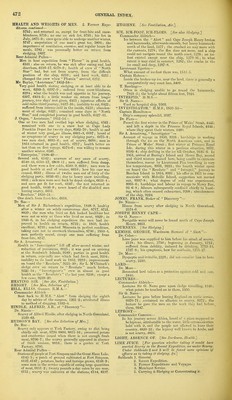
![GENERAL INDEX. EXERCISE. 2. Recent Expedition, continued—■ even in bad weather, 7719 ; most of the crew on deck or outside during the whole day, 7727, 7811; what the work and exercise was, 7811 ; it was taken even in very cold weather, 7813-14 ; sufficient was taken, 7815. Color-Sergeant Wood— He saw that everybody, idlers and cook, took the prescribed exercise, 7879-80 ; every one compelled to take exercise, 7878 ; the lower deck was cleared during the forenoon 7877; he watched to see the men kept off it, 7881; arrangements for work inside and outside, 7883 ; the lower deck always cleared in the forenoon, not necessarily in the afternoon, 7882-4. William Jenkins— What amount of outside exercise he took, 8472-4 ; did not suffer from his duties, 8475. Sir A. Armstrong— The amount, as mentioned in evidence, sufficient to preserve health, 8967; sledge exercise in the spring desirable, 8968 ; assumption that regular exercise was not taken as it is not logged every day, 8969, 9061; was only for two hours a-day, and that not compulsory, but excep- tional, 9061; nothing to show it was taken as recom- mended, 8968, 9271; a want of appetite points to want of exercise, and is unusual in polar regions, 9271. 3. Eormer Expeditions— Dr. Toms— Men in his expedition went out after breakfast in usual walking dress, 3653. Dr. Lyall— Men sent out for exercise twice a-day, 4324. Captain Hamilton— Belcher's Expedition, 1851-23- No compulsory outdoor work but walking, drill, or training (letter of G. Murray), 2996. Yice-Admiral Ommanncy— Outdoor work given to every one every day in Assistance, 5811; the winter routine, 5737 ; open air exercise of the crew, 5737; every one three or four hours in the open air, including idlers, 5812 ; walking training commenced in March, with ten or twelve miles walk, 5810-12 ; and practice in sledging with ballast 5810-12. Mr. Bayley, North Star, 1848-49— Had plenty of exercise, 6262 ; what it was, 6303 ; about four hours a-day, 6339. Assistance, 1852-54— Walking exercise, 6524-7 ; and sledge training and dragging weights, 6524. J. Organ, Enterprise, 1848-49— Work round the ship dragging ballast, harder in the Enterprise than Resolute, but not harder than travelling, 6552-7; what exercise was taken, difference between Enterprise and other ships, 6806-7; about five hoiirs a-day work out of doors, 6556. Resolute 1852-54— What the walking and training was in her or Assisstance, three or four hours of it, 6729-32 ; weather permitting, 6731-2 ; not stopped by weather more than twice a-week, 6735 ; began training as soon as day light thoroughly permitted, i.e., the beginning of March, 6736-8; it lasted a fortnight or so, 6739; more training than in Enterprise, 6807; outside exercise compulsory, dark- ness never preventad it, 6740-52 ; about four or five hours outside the ship through the winter, 6744, 6786 ; exercise and games on board ship when weather pre- vented going out, 6746-52, 6805 ; taken equally all the winter except with much wind, 6808. Mr. Murray, Enterprise, 1850-55— About five and a-half hours a-dav, 6919-20 ; the more the better, 6921. Alexander Cray— In merchant whalers some men would not go out, but felt scurvy in the spring, 7318-19; would sit alldavlono- on their chests, 7374. Dr. Rae— He practised his men before starting, 8885. Sir A. Armstrong, Investigator— Eive and a-half hours' daily exercise taken, 8939 ; daily exercise and hunting sufficient sledge training, 8970 ; to what extent men overtaxed their strength, 8971-2 ; hard work in hunting, 9208; inability of crew to work in 1852, 9219 ; in third winter only a few able to hunt, officers made a point of doing so, 9221-2. EXHAUSTION AND FATIGUE. [See Sledging, Health, Scurvy^] EOOD. [See Diet.'] FOULKE, PORT— Sir G. Nares— Advantage, in exploration, of wintering in so high a lati- tude, otherwise Port Foulke preferable, 135. ERANCOMBE, REUBEN, A.B., of Alert— Sir G. IS ares— Objected to lime juice, but was made to drink it, 57. Color-Sergeant Wood— Was allowed to drink his allowance half at a time, 7964-6. Captain Markham— Attack of scurvy, 596-7. FRANKLIN, SIR JOHN— Dr. Rae— Sledging to Boothia in 1853-54, brought back the first information about Sir J. Eranklin, 8747. Admiral Richards— Possibility of crews having escaped had supporting ships been sent, 3240. FRANZ JOSEPH LAND— Sir G. Nares— Expeditions to Eranz Joseph Land, &c, would advance knowledge, but doubts discovery of 400 miles of coast line on reaching the Pole, 9352. FREDERIC the ESQUIMAUX of Alert — Lieutenant May— Signs of illness the first spring journey, 799; had taken lime juice regularly, 806; was a small eater, 827. Lieutenant Egerton— The only case in Lieutenant Egerton's sledge, 1563 ; not severe, 1566 ; occurred in expedition to Grinnel Land. 1577; had not hard work, 1583; had been sledging before, 1585; wintered in Alert, and been healthy, 1586-7; did not suffer cold, 1589; was clad as the others, 1590; his symptoms, 1598-602 ; never a strong man, 1599 ; continued work nearly the whole time, put on the sledge in hard travelling, 1603 ; had not recovered on return, 1605 ; remedies applied, 1606 ; no idea of its being scurvy, 1607; he took spirits, but was not particu- larly fond of them, 1608-9. Di*. Colan— His illness, 1904-9. Captain Feilden— He suffered badly from scurvy in May, 5975, 5995 ; but stated he would get the Qvan at Disco as an anti- scorbutic, 5976-80; he had it in April and again in May when sledging, 6005 ; had not been sledging before April, 6006; employed on regular ship work, 6008 ; was well on leaving in April, 6010 ; when hnie juice was not carried, 6012 ; but not regularly on the sick list, 6009; it was a decided though not severe case, 6016-18 ; his symptoms, 6017, 6061; he merely managed the dogs when sledging, 6059-60; his symptoms appeared the day of leaving, 6062 ; he was not a great eater, 6064. FROST-BITE— Sir G. Nares— Instructions how to deal with frost-bites given, 245-6 ; after experience in autumn, but little frost-bite occurred, 245 ; they were occasioned by wet feet, 246; necessity of walking in pairs to guard against frost-bite, 247. Captain Markham— Crew healthy except frost-bites, 561. Lieutenant May— Was frost-bitten and lost a toe from going through the ice, 831-3 ; men frost-bitten in autumn sledging, 813-16 ; but continued working, 816. Commander Beaumont— Every one instructed how to deal with them, no cases occurred, 1194. Lieutenant Rawson— Illness of Petersen, frost-bite due to want of quick circu- lation, 1043-8, 1126 ; he being too old for the low temperature ; his age, 1127 ; he was as well clad as the others, 1047 ; symptoms of his case, 1128-33 ; he had been in previous expeditions, 1132 ; was suffering from frost-bite,. 1133 ; measures to protect him when taken ill, 1134, Commander Aldrich— No frost-bite in autumn, 1258. ' Commander Parr— Bad frost-bites in second autumn journcv, 1419 Dr. Colan— What amount of frost-bite there was, 2037-8 ; slow circu- lation most liable to frost-bite, 2120. Dr. Ninnis— Men returned in good health from sledging, except frost- bites, 2503. Dr. Toms— Men suffered slight!v from it in sledging from Pioneer 3711. Mr. Ede— Some cases of it in Assistance, 4171. J. Organ— Had to return from May sledge journey from Enterprise owing to it, 6624-7. Dr. Buzzard— Its occurrence in troops in the Caucasus, particularly in scorbutic men, 5495-6 ; conditions under which it occurred, 5497. Vice-Admiral Ommanney— Occurred sledging from Assistance, 5755; not in winter, 5806 ; one man sent back, 5870 ; six cases of it, 5872-3, 5893 ; due to inexperience at starting, wearing leather boots, 5893. Sir A. Armstrong— On sledging parties in 1851, 9201. 3-AME. [See Meat.']](https://iiif.wellcomecollection.org/image/b24397945_0530.jp2/full/800%2C/0/default.jpg)