Report of the Commitee appointed by the Lords Commissioners of the Admiralty, to enquire into the causes of the outbreak of scurvy in the recent Arctic Expedition ; the adequacy of the provision made by the Admiralty in the way of food, medicine, and medical comforts ; and the propriety of the orders given by the commander o[f] the Expedition for provisioning the sledge parties.
- Great Britain. Admiralty. Committee on Scurvy.
- Date:
- [1877?]
Licence: Public Domain Mark
Credit: Report of the Commitee appointed by the Lords Commissioners of the Admiralty, to enquire into the causes of the outbreak of scurvy in the recent Arctic Expedition ; the adequacy of the provision made by the Admiralty in the way of food, medicine, and medical comforts ; and the propriety of the orders given by the commander o[f] the Expedition for provisioning the sledge parties. Source: Wellcome Collection.
Provider: This material has been provided by London School of Hygiene & Tropical Medicine Library & Archives Service. The original may be consulted at London School of Hygiene & Tropical Medicine Library & Archives Service.
560/570 page 500
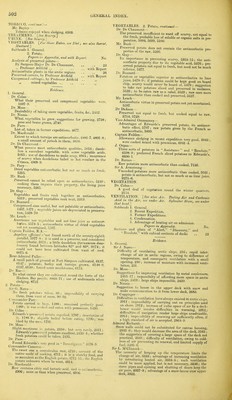
![SPIRITS. 2. Hum, continued— in keeping up a warmth after ceasing dragging, 6767, 6777 ; took it twice a-day, 6769 ; before tenting, 6770 ; tea after supper, 6770. Mr. Murray— Preference for rum at luncheon, 6922 ; not bad to work on, 6923 ; in his expeditions they had it for luncheon, 7016. Alexander Gray— Issued at night, was popular, would have been liked better at lunch, 7216-17. Thomas Rawlings— Taken at night when sledging, 7664; and liked then, 7759-63; assists going to sleep, 7664, 7759-63. Color-Sergeant Wood— Issued at night sledging, 7916 ; advantage of it in giving a glow and producing sleep, 7916-17. Mr. Emmerson— Objects to it when sledging, and prefers tea, 8177 ; useful by giving a glow and inducing sleep, 8177-79 ; specially if taken in tea ; 8179. William Jenkins— Good at night on turning in, 8420. Dr. Rae— Eation of spirits not given in Hudson's Bay Territory, 8808 ; even to officers, owing to desire of keeping it from the Indians, 8809 ; men, even if fond of spirits, would not take it before the work was done, 8810 ; bad effect of rum in a cold climate, 8836 ; no spirits taken sledging, except for fuel, 8807 ; and as a medicine, or to give occasionally, 8873-4 ; it was popular when given, 8874 ; it is not necessary in sledging parties, 8875. Sir A. Armstrong— Might be dispensed with, but adds to the comfort of men after work is over, 9011; they do not work so well on it, 9012. STUCKBEKRY, THOMAS, Petty Officer of Alert— Dr. Colan— Condition after journeys with Lieutenant Giffard and a relief party, 1970-80 ; he became ill after being on board a few days, 1975 ; probablv had symptoms while travel- ing, 1978. SUN, ABSENCE OF. [See DorhtessJ SYLVESTER STOVE. Sir G. Nares— Description of stove, disadvantages of it, 221-2; it cannot be used in steamers without great loss of fuel, 9303. Captain Hamilton— Advantage of it, supplied to former expeditions, 3071-3. Dr. Toms— Method of heating North Star by, 3555-60 ; heating on both North Star and Pioneer was with this stove, 3643-4 ; it was a heating, not a ventilating appa- ratus, 3644-5. Admiral Richards— In Assistance warmth of lower deck dependent on this stove, 3211; its consumption of coal, 3212 ; did not promote ventilation, 3213-14 ; communication of pipes with it, 3214; they did not communicate with open air, 3217 ; no heat from it in the captain's cabin, 3217. Sir L. M'Clintock— Used in Eox, it had no effect on the lower deck ventila- tion, 3384 ; the warming of Intrepid by stoves proved better than it, 3384. Dr. Scott— Intrepid warmed by Sylvester stove, 3891; description of it, 3892-5 ; it did not warm his cabin, 3896-7 ; '_' Resolute had a Sylvester stove with tubing, 3908-9 ; it was more for heating than ventilation, 4019. Mr. Ede— Assistance warmed by Sylvester stove, 4050 ,- passing through his cabin, 4051 ; whether the hot air escaped and was renewed by fresh air, 4052-4 ; the moisture was driven off by the stove, 4237. Dr. Lyall— In Assistance 1852-54, where the stove opened, 4277, 4279-80; preference for it with sufficient coal, requiring a good deal, 4326-7. Dr. Piers— Had one in Investigator, 4490—91; no opening from the stove into his cabin, 4498 ; not fresh hot air, 4500 ; believes it did not admit fresh air, 4664 ; but warmed the air in the ship, 4665. Dr. Macdonald— What it is, 4828. Vice-Admiral Ommanney— Description^'ope in Assistance, 5731: what apertures it had, 5733-5 ; officers complained of too much hot air from it, 5736 ; its warm air flues did not extend to the captain's cabin, 5736 ; air from Sylvester stove was heated on admission, 5794. Rear-Admiral Pullen— Used in North Star, 6217. Mr. Bay ley— Did not come before the fore part of the fore hatchway in the Assistance, 6513. J. Organ— One used in Enterprise in 1848-49, 6535-6. SYLVESTER STOVE, continued- Mr. Murray— Had one in Enterprise in 1850-55, 6947; which warmed the ship well, 6948; better ventilated than Investigator, 6949. Sir A. Armstrong— H.M.S. Investigator was warmed by it, 8940 ; account of the stove, tubes communicating with cabins, dissemi- nation of hot air through the ship, 8940-41 ; it commu- nicated with the outer air, 8942-3, 9070 ; not directly, 9071 ; preference for it over mode of ventilation of recent arctic ships, 8945 ; provided there is a good supply of coal and it can be kept alight, 8945-6. SYMONDS, ROBERT, A.B. of Alert— Dr. Colan— Case of Robert Symonds, who had been with Lieutenant Giffard, 1910-13. TARTARIC ACID. [See Acid.'] TAWS, E., Ice-quartermaster of Discovery. Dr. Ninnis— Scurvy after sledging in North Greenland, 2564-6. TEA. (Unless otherwise specified, remarks refer to Sledging.) Analysis of Compressed Tea by Mr. Bell, with Report— Evidence. Sir G. Nares— Preference for tea, 106 ; given for lunch in lieu of spirits formerly taken, 107-8, 193 ; men work better after it at luncheon, 195 ; greatly appreciated, 181 ; advantage of lea, but disadvantage of halt for, at luncheon, 192, 197-8 ; allowance increased if rum decreased, advantage of the change, but disadvantage of halt for luncheon, 192, 197-8. Captain Markham— Would not recommend additional tea, 663; tea-leaves eaten as a vegetable, did not think it would have any effect, 738 ; temperance men had overplus of tea, 742. Commander Beaumont— Men sledging did not care about spirits, except in tea, 993 ; given at luncheon, 994 ; men worked better after, 995. Lieutenant Rawson— It cannot be too highly spoken of, 1160. Lieutenant Giffard— Advantage of it, men looked forward to it, 1232 ; tea and spirits given separately, 1247. Commander Aldrich— Description of compressed tea, its advantage in measure- ment and strength, 1295 ; to what extent he used it, 1401 ; preference for tea at luncheon, but disadvantage of halt except when working half loads, 1296 ; advocates it in middle of the day, 1405 ; advantage of it at night, and how taken, 1401. Dr. Colan— Of more advantage than rum, 2021 ; prefers it for luncheon, 2022 ; men more vigorous and able to endure fatigue, 2023-4; advantage of compressed tea, 2127 ; chewing tea-leaves not antiscorbutic, 2141-2. Dr. Moss- Preference for luncheon instead of rum, 2421, 2447 ; work better done, 2446 ; preference for tea, 2475 ; advantage of compressed tea, 2446 ; better than ordinary tea, 2467 ; retains its flavour, and is more easily made, 2468; tea- leaves may have assisted as antiscorbutics, 2469. Dr. Ninnis— Tea always welcome, 2712 ; its comforting effects greater than rum, even when not sledging, 2716; better than rum for luncheon, but the longer halt objectionable, 2715-16 ; better during working hours, 2730. Admiral Richards— Would not exclude tea or ram, 3175; tea very much prized, 3176. Captain Hamilton— Warmth produced by mixing rum and tea, due to mixture, not to either alone, 3084-7 ; some preferred tea for lunch, 3009 ; tea better than rum, 3084. Captain Hobson— Great value of tea, 3547 ; men expressed themselves willing to give up rum rather than tea, 3550. Dr. Tonis— Time it takes to make, 3757; the halt would be injudicious in checking perspiration, 3758. Captain A. Young— Attaches much value to tea, 3878 ; would take both it and rum sledging, it in preference, 3804-6. Dr. Scott— Tried compressed tea in China, and did not care for it, 3945 ; only the commoner kinds compressed there, 3946 ; would prefer tea to rum, 3956 ; considers the halt for it at luncheon injurious in excessive cold, 3956-7. Mr. Ede— Preference for tea over rum, 4100 ; should be given at mid- dav when undergoing exertion, 4104. Dr. Lyall— Prefers rum at night and tea for mid-day meal, 4313, L415 ; but objects to a long halt for making it 4313; tea good in its way, 4312](https://iiif.wellcomecollection.org/image/b24397945_0560.jp2/full/800%2C/0/default.jpg)