Report of the Commitee appointed by the Lords Commissioners of the Admiralty, to enquire into the causes of the outbreak of scurvy in the recent Arctic Expedition ; the adequacy of the provision made by the Admiralty in the way of food, medicine, and medical comforts ; and the propriety of the orders given by the commander o[f] the Expedition for provisioning the sledge parties.
- Great Britain. Admiralty. Committee on Scurvy.
- Date:
- [1877?]
Licence: Public Domain Mark
Credit: Report of the Commitee appointed by the Lords Commissioners of the Admiralty, to enquire into the causes of the outbreak of scurvy in the recent Arctic Expedition ; the adequacy of the provision made by the Admiralty in the way of food, medicine, and medical comforts ; and the propriety of the orders given by the commander o[f] the Expedition for provisioning the sledge parties. Source: Wellcome Collection.
Provider: This material has been provided by London School of Hygiene & Tropical Medicine Library & Archives Service. The original may be consulted at London School of Hygiene & Tropical Medicine Library & Archives Service.
561/570 page 501
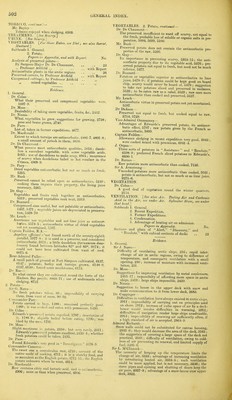
![TEA, continued— Dr. Macdonald— Has not proved beneficial instead of rum, 4867 ; doubts of its being antiscorbutic, instance of its beneficial use when scurvy was prevalent in the fleet, 4867. Dr. De Chaumont— Preferable to rum sledging, 5101. Dr. Pavy— — Sharpens the faculties and promotes bodily and mental work, 5212. Dr. Guy— Owing to its accompanying warmth, much preferable to alcohol, 5415. Vice-Admiral Ommanney— Sometimes preferred to rum, not given for luncheon, but after tenting when sledging from Assistance, 5771-3, 5914. Capt. Feilden— Preference for it over rum, 5961 ; it is best for travelling on, 5962. Mr. Bay ley— Tea popular at night sledging, 6500-1. J. Organ— Did not prevent sleep, 6775-6 ; took it after supper, 6770. Mr. Murray— Objection to recent parties having had tea for luncheon, 7015 ; making tea wastes time, 6922. Alexander Gray— About a pint of tea given, 7491. Thomas Rawlings— Preference for tea at luncheon, 7665 : tea was liked, 7851 ; and was hot when drunk, 7852. Color-Sergeant Wood— When taken, 7912-13 ; preference for. over rum, 7914-15, 7918. Mr. Emmerson— Objects to rum whilst travelling, prefers lea, 8177 ; taken twice a day, 8180. William Jenkins— Tea best for travelling, 8420. Dr. Kae— Objections to tea in the middle of the day, on account of the halt, 8841 ; in Hudson's Bay service it is never issued, but can be bought, 8715. Sir A. Armstrong— Preferable to rum for lunch, 9012. TEMPERANCE. [See Abstainers.'] TEMPERATURE. [See also Ventilation, Sledging. Unless otherwise shown, statements relate to Sledging. Tempera- ture of Body, see Scurvy']. Papers in Appendix. ■No- Abstract of return of Alert . . .. ■ • • • 8 „ „ Discovery .. .. 14 Sledge party returns, showing the weather, the distance travelled, and the condition of the party— By Captain Markham .. .. ■ ■ .. 15 ,, Commander Beaumont.. .. .. 16 ,, Lieutenant Giffard .. . . .. 17 „ Commander Aldrich . . .. .. 18 Statements in Nosological Returns .. .. 32 Evidence. I!' Sir G. Nares— Temperature of lower deck of Alert, between 40 and 50 degrees, 223 ; where the thermometers were placed, 224 ; never very low in holds, 232. Captain Stephenson— What the temperature in Discovery of cabins and lower deck was, 440. Captain Markham— When sledging, temperature below zero in his sleeping bag, 649 ; the greatest cold, —45 degrees, 678 ; on 9th May, about zero, had been lower, 616-17 ; inability to keep warm in sleeping bag, 680. Commander Beaumont — What effect extreme cold had on the men, 365 C ; men cannot sit down at luncheon in it. 966; the lowest, 947. Lieutenant Giffard— The cold prevented sleep, 1218 ; what the lowest tempera- ture was, 1217. Commander Pelham Aldrich— The Esquimaux, and Greenlander felt cold more than others in autumn, 1322 ; their clothing had to be supplemented, 1324, 1387; the Esquimaux most, 1387 ; Esquimaux sealskin never thoroughly dry, 1324; temperatures'ex- perienced, 1304, 1325. Admiral Richards— Average temperatures, 3099 ; they are not any test of men's feelings, 3100 ; men suffer very much in low tempera- tures, 3100; low temperature sledging prevented men sleeping on journey from Assistance to North Star, 3219-20 ; greater cold in recent expedition, 3101. What difference there Mils in temperature in Assistance on deck and on the Hoc, 3166 ; temperature on board, 3215; the moisture frozen at night; continued dropping with high temperature except in captain's cabin, 3216. TEMPERATURE, continued- Sir L. M'Clintock— The average gives an estimate of the weather, 3247; temperature of the air of Fox used to be kept between fifty and fifty-five degrees, 3338. Dr. Toms— What the temperature was, 3685, 3704-5. Mr. Ede— What the temperature was, 4137, 4247. Dr. Piers— Low temperature, December, 1852, 4647-8. Dr. Macdonald (on board) — In arctic sea might be lower than in England, 4841 ; persons accustomed to the arctics suffer from high temperatures, 4841. Dr. Pavy— Extreme cold drives the blood to the centre of the body, exposure to heat induces increase of vascularity, 5203. Vice-Admiral Ommanney— Those outside and on board Assistance in the winter 1850-51, 5791 ; cold not greater from unfavourable position of the ship on the open floe, 5879. Mr. Bayley— Injurious effects of extreme cold in a journey in February, 6419-35 ; loss of appetite entirely due to cold, 6494. Color-Sergeant Wood— Perspired freely, 8066 ; did not suffer from cold during halt, but kept moving, 8067-8. Sir A. Armstrong— Thermometers tested before and corrected when mercury froze, 9263-5. TENTS. [See Sledging and Equipments.] THIRST WHEN SLEDGING. [See also Sledging.] Captain Markham— Men suffered from it, 641. Commander Beaumont — Not much suffering after first t wo days, 972. Lieutenant Giffard— Did not suffer from it, 1237. Commander Parr, Dr. Colan— Pemmican did not produce it, 1498,1786. Admiral Richards— Sufferings from it, 3107. Captain Hobson— Snow increased it, 3515. Mr. Busk- Is created by pemmican, 5255. Color-Sergeant Wood— Extent to which they suffered, 7981. THORS, JOHN, Ice-quartermaster of Alert (also spelt THORES). Dr. Colan— Had scurvy, after two short journeys, 1870-78 ; was not ill during his expeditions, 1874. TIDE. Commander Beaumont— What it is on the Greenland side, 867-9. Commander Aldrich— To what extent the tide may affect the ice-foot; no great tide, 1286. TOBACCO. (References chiefly relate to Sledging.) Commander Aldrich— Advantage of, at night, 1401. Commander Parr— Men did not smoke much, smoked himself, 1466-7 ; diffi- culty about it in cold weather, 1468 ; one man smoked and chewed tobacco, his exemption from scurvy, 1469-72 ; smokers did not care for it sledging, 1467. Dr. Colan— No harm in it, 2143. Dr. Moss— Injurious, 2476-8, 2480. Dr. Ninnis— Lessens inclination to work, difficulty of keeping a pipe alight in the open air, 2732. Dr. Coppinger— Allowance might be reduced, 2949 ; Drake, a marine, who chewed, did not suffer from scurvy, 2950, 2958. Captain Hamilton— Smoking disagreeable to non-smokers, but beneficial to smokers, 3010-11. Admiral Richards— Smoking difficult except at night in bags, 3138. Captain Hobson— Was used, 3435 ; little chewing, but smoking liked at night and on halting, 3436, 3537 ; whether his attack of scurvy was attributable to it, 3535-36. Dr. Scott- Smoking should not be begun in the arctics, 3936. Dr. J,vail— Tobacco in moderation advantageous, 432S.» Dr. Pavy— In moderation advant ageous, 5213 ; and should he taken in arctic expeditions, 5214. Dr. Guy— Prisoners will go through almost anything to get a sltiokej 5415 ; its advantage as a comfort, 3415.](https://iiif.wellcomecollection.org/image/b24397945_0561.jp2/full/800%2C/0/default.jpg)