Volume 1
The history and antiquities of the county of Dorset / Compiled from the best and most ancient historians, inquisitions post mortem, and other valuable records and mss. in the public offices, and libraries, and in private hands. With a copy of Domesday book and the Inquisitio Gheldi for the county: interspersed with some remarkable particulars of natural history; and adorned with a correct map of the county, and views of antiquities, seats of the nobility and gentry, &c. By John Hutchins, M.A.
- John Hutchins
- Date:
- 1774
Licence: Public Domain Mark
Credit: The history and antiquities of the county of Dorset / Compiled from the best and most ancient historians, inquisitions post mortem, and other valuable records and mss. in the public offices, and libraries, and in private hands. With a copy of Domesday book and the Inquisitio Gheldi for the county: interspersed with some remarkable particulars of natural history; and adorned with a correct map of the county, and views of antiquities, seats of the nobility and gentry, &c. By John Hutchins, M.A. Source: Wellcome Collection.
101/804 (page 1)
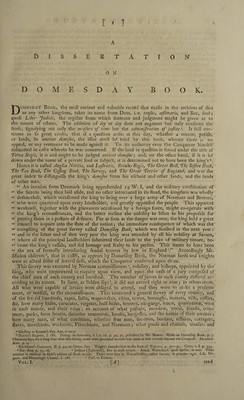
![DISSERTATION 0 N DOMESDAY BOOK. Domesday Book, the moil ancient and valuable record that exifts in the archives of thia or any other kingdom, takes its name from Dom, i.e. cenfus, aejlimatio, and Boc, book; quafi Liber Judicii, the regifter from which fentence and judgment might be given as to the tenure ot eilates. The addition of dey or day does not augment but only confirms the fenfe, fignifying not only the mcafure of time but the adminif ration of jujlice \ It ftill con¬ tinues in fo great credit, that if a queftion arifes at this day, whether a manor, parifh, or lands, be ancient demefne, the ifiue muft bd tried by this book, whence there is no appeal, or any averment to be made againft it. To its authority even the Conqueror himfelf lubmitted in cafes wherein he was concerned. If the land in queftion is found under the title of Terra Regis, it is and ought to be judged ancient demefne; and, on the other hand, if it is fet down under the name of a private lord or fubjedt, it is determined not to have been the king’sb. Hence it is called Anglice Notitia, and Lujiratio, Rotulus Regis, The Great Roll, The SeJJion Book, The Tax Book, The CeJJing Book, The Survey, and The Great Terrier of England, and was the great index to diftinguifh the king’s demefne from his efeheat and other lands, and the lands of other men. “ An invalion from Denmark being apprehended 19 W. I, and the military conftitution of “ the Saxons being then laid afide, and no other introduced in its ftead, the kingdom was wholly “ defencelefs, which occafioned the king to bring over a large army of Normans and Bretons, “ who were quartered upon every landholder, and greatly opprefted the people. This apparent “ weaknefs, together with the grievances occafioned by a foreign force, might co-operate with “ the king’s remonftrances, and the better incline the nobility to liften to his propofals for “ putting them in a pofture of defence. For as foon as the danger was over, the king held a great “ council to inquire into the ftate of the nation; the immediate confequence of which was the “ compiling of the great furvey called Botnefday Book, which was finished in the next year: “ and in the latter end of that very year the king was attended by all his nobility at Sarum, “ where all the principal landholders fubmitted their lands to the yoke of military tenure, be- came the king’s vaffals, and did homage and fealty to his perfon. This feems to have been <c the aera of formally introducing feudal tenures by law in Englandc.” Accordingly Mr. Madox obfervesd, that in 1086, as appears by Domefday Book, the Norman lords and knights were in actual feifin of feveral fiefs, which the Conqueror conferred upon them. This furvey was executed by Norman commifiionerse, nobility, and bifhops, appointed bv the king, who were empowered to enquire upon view, and upon the oath of a jury compofed of the chief men of each county and hundred. The number of jurors in each county differed ac¬ cording to its extent. In fome, as Selden fays f, it did not exceed eight or nine; in others more. All who were capable of l’ervice were obliged to attend, and they were to make a prefent- ment, or verdidt, to the commifiioners. This contained a general furvey of every county, and of the fewral hundreds, rapes, laths, wapentakes, cities, towns, boroughs, manors, vills, caftles, &c. how many hides, carucates, virgates, half-hides, bovates, ox-gangs, leucre, quarentenae, were in each manor, and their value ; an account of what pafiure, meadow, wood, forefts, com¬ mons, parks, farm houfes, demefne tenements, houfes, burgeffes, and the names of their owners ; how many men, of what condition, whether free men, foc-men, bordars, villains, cottagers, llaves, merchants, workmen, Frenchmen, arid Normans; what goods and chattels, trealurc and 4 GlofTary to Kennel’s Pat*. Ant. in voce. b Hobart’s Reports, t. 188. Dialog, de Scaccario, 1. i. c. 16. p. 30, 31, publifhed by Mr. Madox. Webb on Domefday Book, p. 7. Chauneey fays, for a long time after this furvey, none' were permitted to make any claim or title to lands beyond the Conqueft. Hertlord- fhire, p. y. c Blackftone’s Comment. II. p. 49. ex Chron. Sax. Wright’s Introduction to the Law of Tenures, p. $2—£7. Carte, v. I. p. 444. d Bar. Ang. p. 25, 26. e Juftices \Jufiiciarii\, five in each county. Annal. Waverlienf. apud Spelm. in voce. Their number is omitted in Gale’s edition of thofe annals. There were four in Worcelterlhire, called bar ones, or principes regis. Lib. Wi- gorn. and Hemmingii Chartul. I. 28S. f Pref. to Kadmer. Vol. I< [A] read](https://iiif.wellcomecollection.org/image/b30456496_0001_0101.jp2/full/800%2C/0/default.jpg)