Volume 1
The history and antiquities of the county of Dorset / Compiled from the best and most ancient historians, inquisitions post mortem, and other valuable records and mss. in the public offices, and libraries, and in private hands. With a copy of Domesday book and the Inquisitio Gheldi for the county: interspersed with some remarkable particulars of natural history; and adorned with a correct map of the county, and views of antiquities, seats of the nobility and gentry, &c. By John Hutchins, M.A.
- John Hutchins
- Date:
- 1774
Licence: Public Domain Mark
Credit: The history and antiquities of the county of Dorset / Compiled from the best and most ancient historians, inquisitions post mortem, and other valuable records and mss. in the public offices, and libraries, and in private hands. With a copy of Domesday book and the Inquisitio Gheldi for the county: interspersed with some remarkable particulars of natural history; and adorned with a correct map of the county, and views of antiquities, seats of the nobility and gentry, &c. By John Hutchins, M.A. Source: Wellcome Collection.
201/804 (page 25)
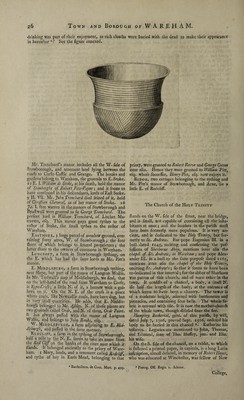
![Slepe is a little hamlet, lying about two miles S. E. of Arne, of which it is a member, and has always belonged to the fame lords as Arne. Haymore, formerly a moor, now a meadow, fituate about two miles E. from Wareham, is bounded on the E. and S. by Arne; on the N. by the bay of Pool ; on the W. by a flexure of the river Frome. In old evidences it is faid to be in the parifh of the FI. Trinity, in Wareham, and is now reputed to be in the chapelry of Arne ; though it is not rated to church and poor, nor pays tythe to any place. It contains twenty acres, and is anything in conjunffion with Earls Mead. Robert de Novo Burgo, or New- burgh, gave the moor called Haymore, without Wareham, with the faline and fiffiery, to the abby of Bindon, but it did not take effed ; for afterwards it belonged to the Newburghs and Marneys, who held it . . . Hen. VIII. of the king, as of his manor of Wareham. 3 and 4 Phil, and Mary, it was granted to fir George de la Lind, and valued at 13 s. 4d. But he feems to have been only leflee under the heirs of the Newburghs; for, 24 Eliz. lord Hozvard of Bindon held it as the New¬ burghs did. It now belongs to J. Banks, efq. Ridge, a little E. of Redcliffe, is only a fingle te¬ nement belonging to Arne. Earls-mead, is now divided into meadows on the W. fide of Wareham Caufeway, confiding in all of about twenty acres. It might take its name from being the demefne lands of the Clares earls of Gloucejler and Hereford, once lords of Wareham. It makes a tything in conjunction with Haymore, and is rated to church and poor in that part of the parifh which lies within the borough. It was fold with the fifhery in the hoop net, Caftle-Clofe, and twelve tenements in the town, to John Calcraft, efq. about 1768. Stowborough is a tything and village, confiding of forty houfes, a little S. from Wareham, to which it feems a fuburb. The name intimates a place of a town or borough. It does not occur in Domefday-Book. Mr. Etterick in his additions to Dorietfhire, in Mr. Camden’s Bri¬ tannia, countenances an ancient tradition of the inha¬ bitants, that it was the mother-town of Wareham, which rofe by its decay, as Salifbury did out of Old Sarum; and fuppofes its being governed by a mayor is an evidence that it has been formerly more confi- derable, and that the natural drength of Wareham might, among other things, invite the inhabitants to remove hither; but neither our hidorians or records fupport this opinion. The former are quite filent, and the latter feldom or never dyle it a borough. It had a mayor formerly, and, as Mr. Willis fays, pre¬ tended to fome ancient privileges, but he does not in¬ form us what they were l. The mayor was chofen at Mr. Pitt’s court, at Michaelmas, by the jury; but the office funk when the Schifm A<d took place, 1714; the inhabitants being chiefly Diffenters declined to qualify themfelves. In the room of the mayor, an officer called a bayliffis dill chofen, in the fame man¬ ner as the mayor was, but is no more than a tything man, which might have been always the cafe. This feems to have been the principal manor. It contains the E. part of the vill. 32 Eliz. this borough was granted to Richatd Swaync and 1 homes Freaks. Afterwards it came to William Pitt, efq. and now belongs to his de¬ fendant, George Pitt, efq. We have little ancient ac¬ count of it, but it feems to have belonged to the priory of Wareham before the diffolution. At the S. end of Stowborough, in the road to Orange, dood a barrow, called King-Barrow, 100 feet diameter, its perpendicular height 12 feet. On ^'g§,nS R down, Jan. 21, 1767, to make the turn¬ pike road, the following difcovery was made. The barrow was compoled of drata, or layers of turf, in fome of which the heath was not penfhed. In the contei, at the bottom, even with the iurface of the gi ound, in the natural foil of land, was found a very laige hollow trunk of an oak, rudely excavated, ten feet long, the outer diameter four feet, that of the cavity three feet. It lay horizontally S. E. and N. W. The upper part and the ends were much rotted. In the cavity weie found as many human bones, un¬ burnt, black, and loft, as might be contained in a quarter of a peck ; viz. a bone of an arm, two thigh¬ bones, two blade-bones, the head of the humerus, part of the pelvis, and feveral ribs. Thefe lad would lap round the finger. There were no remains of the fcull. Many were fcattered and lod; others entirely confumed ; and all had been wrapped up in a large covering, compofed of feveral Ikins, fome as thin as parchment, others much thicker, efpecially where the hair remained, which fnewed they were deer Ikins. They were in general black, but not rotten; neatly fown together; and there were many fmall flips, whofe feams or ditches were fcarce two inches afunder. As the labourers expe&ed to find money, thefe were pulled out with much eagernefs, and fo torn, that the Ihape of the whole could not be difcovered. This wrapper feemed to have been paffed feveral times round the body, and in fome parts adhered to the tiunk. In the middle of it the bones were comprefled flat in a lump, and cemented together by a glutinous matter, perhaps the moidure of the body. On un¬ folding the wrapper, a difagreeable fmell was per¬ ceived, fuch as isufual at the fird opening of a vault. A piece of what was imagined to be gold lace] four, inches long, two and a half broad, duck on the infide of the wrapper, very black, and much decayed. Bits of wire plainly appeared in it. There were no fragments of iron or brafs, whence one might have concluded any arms or armour were depofited here. Near the S. E. end was found a fmall veflel of oak, of a black colour. It was much broken, but enough was preferved to ffiew it was in the fliape of an urn. On the outfide were hatched, as with a graving tool, many lines, fome horizontal, others oblique. Its long diameter, at the mouth, is three inches; the fliort one, two ; its depth two ; its thicknefs of an inch. It was probably placed at the head of the corps. There being no appearance of any allies in it, or in any part of the covering, if it was not the ge¬ neral opinion that the Danes loved larger draughts, and more capacious bowls, it would feem mod probable that it was the drinking cup of the per- fon buried here, who, by the name of the bar- row, was probably a perfon of rank, military or civil. Why might not this have been intended for the ufe of the deceafed in the other world, where * Not. Parliam. v. ii. 490. VOL. I. G](https://iiif.wellcomecollection.org/image/b30456496_0001_0201.jp2/full/800%2C/0/default.jpg)