Ethnology : in two parts, I. Fundamental ethnical problems. II. The primary ethnical groups / by A.H. Keane.
- Augustus Henry Keane
- Date:
- 1896
Licence: Public Domain Mark
Credit: Ethnology : in two parts, I. Fundamental ethnical problems. II. The primary ethnical groups / by A.H. Keane. Source: Wellcome Collection.
396/484 page 360
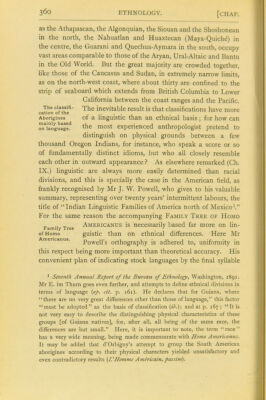
![as the Athapascan, the Algonquian, the Siouan and the Shoshonean in the north, the Nahuatlan and Huaxtecan (Maya-Quiche) in the centre, the Guarani and Quechua-Aymara in the south, occupy vast areas comparable to those of the Aryan, Ural-Altaic and Bantu in the Old World. But the great majority are crowded together, like those of the Caucasus and Sudan, in extremely narrow limits, as on the north-west coast, where about thirty are confined to the strip of seaboard which extends from British Columbia to Lower California between the coast ranges and the Pacific. The ciassifi- inevitable result is that classifications have more cation of the Aborigines of a linguistic than an ethnical basis; for how can oJTianguage^ the most experienced anthropologist pretend to distinguish on physical grounds between a few thousand Oregon Indians, for instance, who speak a score or so of fundamentally distinct idioms, but who all closely resemble each other in outward appearance ? As elsewhere remarked (Ch. IX.) linguistic are always more easily determined than racial divisions, and this is specially the case in the American field, as frankly recognised by Mr J. W. Powell, who gives to his valuable summary, representing over twenty years' intermittent labours, the title of Indian Linguistic Famihes of America north of Mexico^ For the same reason the accompanying Family Tree of Homo ^ ., „ Americanus is necessarily based far more on lin- Family Tree _ _ _ •' of Homo guistic than on ethnical differences. Here Mr Americanus. Powell's Orthography is adhered to, uniformity in this respect being more important than theoretical accuracy. His convenient plan of indicating stock languages by the final syllable ^ Seventh Annual Report of the Bureati of Ethnology, Washington, 1891. Mr E. im Thurn goes even further, and attempts to define ethnical divisions in terms of language (op. cit. p. 161). He declares that for Guiana, where there are no very great differences other than those of language, this factor must be adopted as the basis of classification (ib.)\ and at p. 167 ; It is not very easy to describe the distinguishing physical characteristics of these groups [of Guiana natives], for, after all, all being of the same race, the differences are but small. Here, it is important to note, the term race has a very wide meaning, being made commensurate with Homo Americanus. It may be added that d'Orbigny's attempt to group the South American aborigines according to their physical characters yielded unsatisfactory and even contradictory results i^VHomme Am^ricain, passim).](https://iiif.wellcomecollection.org/image/b21500666_0396.jp2/full/800%2C/0/default.jpg)