Ethnology : in two parts, I. Fundamental ethnical problems. II. The primary ethnical groups / by A.H. Keane.
- Augustus Henry Keane
- Date:
- 1896
Licence: Public Domain Mark
Credit: Ethnology : in two parts, I. Fundamental ethnical problems. II. The primary ethnical groups / by A.H. Keane. Source: Wellcome Collection.
418/484 page 382
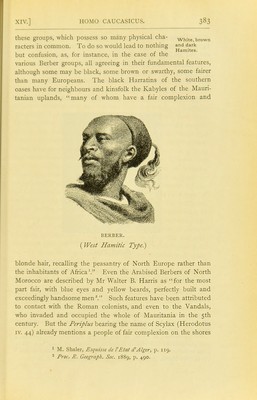
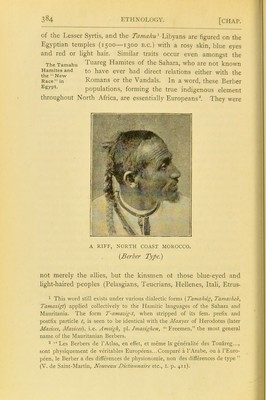
![also very black skins. Some even of the Sudanese Arabs, notably the Sheygyeh people between Dongola and Abu-Hammed, are remarkable for their extremely dark complexion, although claiming pure Arab descent. So also the Dasas, or Southern Tibus of the Sahara north of Lake Chad, and the Harratin, or Black Berbers of Tidikelt and the Saharan oases, many of whom are blacker than the average Negro. But it may be asked, on what ground are these dark groups „^ . , . included in the light-coloured Caucasic division, Physical cha- ' ractersofHomo where their very presence seems to involve a con- Caucasicus. tradiction in terms ? The reason is, because they cannot be separated anthropologically from that connection. Apart from the colour, which in some cases appears to be the result of climate and in others is certainly due to an infusion of Negro blood, these black Caucasians, if the expression can be tolerated, are amongst the very finest representatives of the Caucasic type. According to Messrs Flower and Lydekker, this type is distinguished generally by light skin, though in aberrant groups as dark as the Ethiopic; hair ranging from fair to black, soft, straight or wavy, in transverse section intermediate between the flat Ethiopic and round Mongol; full beard; skull variable, though mostly mesocephalic ; jugal bones retreating ; face narrow and projecting in the middle Hne (pro-opic); orbits moderate; nose narrow and prominent (leptorrhine); jaws orthognathous; teeth small (microdont)With regard to Huxley's blonde and dark divisions, these anthropologists hold that, despite differences of colour of eye and hair, they agree so closely in other respects that they are best regarded as modifications of one great type than as primary divisions. In any case they are now mostly blended together in diverse proportions, and even the blonde, though found chiefly in North Europe, extends to North Africa [where in fact it originated] and eastwards to Afghanistan. In this careful survey of the whole field, the dark division receives its full expan- sion, comprising not only black hair and eyes, but also a skin of almost every shade from white to black (p. 753). There is thus no reason to create separate divisions for all](https://iiif.wellcomecollection.org/image/b21500666_0418.jp2/full/800%2C/0/default.jpg)