Ethnology : in two parts, I. Fundamental ethnical problems. II. The primary ethnical groups / by A.H. Keane.
- Augustus Henry Keane
- Date:
- 1896
Licence: Public Domain Mark
Credit: Ethnology : in two parts, I. Fundamental ethnical problems. II. The primary ethnical groups / by A.H. Keane. Source: Wellcome Collection.
461/484 page 425
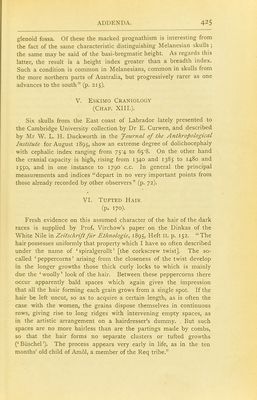
![glenoid fossa. Of these the marked prognathism is interesting from the fact of the same characteristic distinguishing Melanesian skulls ; the same may be said of the basi-bregmatic height. As regards this latter, the result is a height index greater than a breadth index. Such a condition is common in Melanesians, common in skulls from the more northern parts of Australia, but progressively rarer as one advances to the south (p. 215). V. Eskimo Craniology (Chap. XIII.). Six skulls from the East coast of Labrador lately presented to the Cambridge University collection by Dr E. Curwen, and described by Mr W. L. H. Duckworth in the Journal of the Atithropological Institute for August 1895, show an extreme degree of dolichocephaly with cephalic index ranging from 75*4 to 65-8. On the other hand the cranial capacity is high, rising from 1340 and 1385 to 1480 and 1550, and in one instance to 1790 c.c. In general the principal measurements and indices depart in no very important points from those already recorded by other observers (p. 72). VI. Tufted Hair (p. 170). Fresh evidence on this assumed character of the hair of the dark races is supplied by Prof. Virchow's paper on the Dinkas of the White Nile in Zeitschriftfur Ethnologie, 1895, Heft li. p. 152. The hair possesses uniformly that property which I have so often described under the name of ' spiralgerollt' [the corkscrew twist]. The so- called ' peppercorns' arising from the closeness of the twist develop in the longer growths those thick curly locks to which is mainly due the ' woolly' look of the hair. Between these peppercorns there occur apparently bald spaces which again gives the impression that all the hair forming each grain grows from a single spot. If the hair be left uncut, so as to acquire a certain length, as is often the case with the women, the grains dispose themselves in continuous rows, giving rise to long ridges with intervening empty spaces, as in the artistic arrangement on a hairdresser's dummy. But such spaces are no more hairless than are the partings made by combs, so that the hair forms no separate clusters or tufted growths ('Biischel'). The process appears very early in life, as in the ten months' old child of Amol, a member of the Req tribe.](https://iiif.wellcomecollection.org/image/b21500666_0461.jp2/full/800%2C/0/default.jpg)