Ethnology : in two parts, I. Fundamental ethnical problems. II. The primary ethnical groups / by A.H. Keane.
- Augustus Henry Keane
- Date:
- 1896
Licence: Public Domain Mark
Credit: Ethnology : in two parts, I. Fundamental ethnical problems. II. The primary ethnical groups / by A.H. Keane. Source: Wellcome Collection.
62/484 page 26
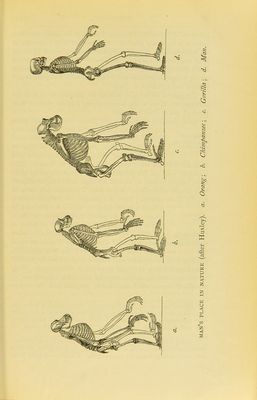
![much longer in men than in apes relatively to the arms. 5. Great toe, longer in man, and not opposable to the other digits. Although this is one of the most marked differences between the two families, it is not a strong zoological character, since it depends on a sHght change in the form of a single bone (the entocuneiform); in the human embryo also the hallux (great toe) is opposable till the fourth month*, 6. Nose, well developed in rnan, very slightly prominent in the Apes, except the Hoolock Gibbon, in which it is aquiline. 7. Dentition, forms in man alone an uninterrupted series of horse-shoe shape, without prominent canine teeth; but the canines of the lower and higher races differ, the crown of the former • being larger relatively to the neck, and terminating, Hke those of the Apes, in a sharp point, usually much worn (F. Regnault). 8. Chin, developed in man alone, though in one Gibbon (Siamang) the union of the mandibles forms a slight projection like the human chin. On the other hand there is no chin in the jaw of the Cannstadt [Spy] race, and the large angle approaches without nearly equalling that of the anthropoids (Cope, Genealogy of Man, Amer. Naturalist, April 1893, p. 330). 9, Hair, covers the whole body in all the Anthropoids, restricted mainly to the scalp and parts of the face in man ; the human hair is woolly, or quasi-woolly in Homo ^Ethiopicus, never in any of the true apes, or even of the half-apes, except the Woolly Lemur (Avahis laniger) of Madagascar. Greyness with years is also a human feature, although the tendency has been observed in Gorilla, Traditional reports regarding hairy men have been verified only in the case of the Ainu people of North Japan, Avith whom the character is certainly racial. 10. Voice, inarticulate in all anthropoids; articulate in all the hominidte, who conse- quently are alone endowed with the gift of speech. This, with the associated intellectual quahties, separates man altogether from his anthropoid congeners, and consequently from all other ' Jusqu'au troisieme mois de la vie intra-uterine I'articulation du gros orteil du foetus humain est oblique, exactement comme chez les singes; c'est seulement au quatrieme mois qu'on la trouve transformee (Salmon, Races Humaines Prihistoriques, p. 4). The great toe is still somewhat opposable among the Annamese, who from this circumstance have always been known to the Chinese as Giao-Chi or Crosstoes.](https://iiif.wellcomecollection.org/image/b21500666_0062.jp2/full/800%2C/0/default.jpg)
 No text description is available for this image
 No text description is available for this image
 No text description is available for this image