Ethnology : in two parts, I. Fundamental ethnical problems. II. The primary ethnical groups / by A.H. Keane.
- Augustus Henry Keane
- Date:
- 1896
Licence: Public Domain Mark
Credit: Ethnology : in two parts, I. Fundamental ethnical problems. II. The primary ethnical groups / by A.H. Keane. Source: Wellcome Collection.
87/484 page 51
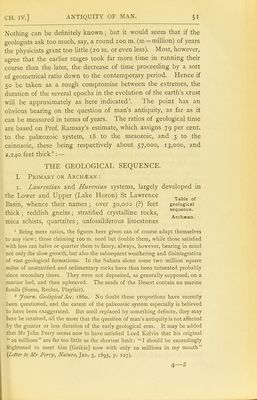
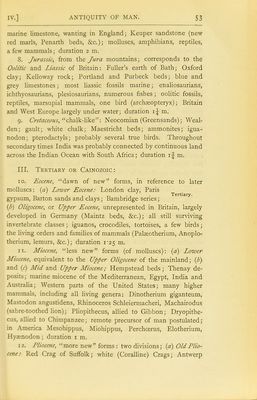
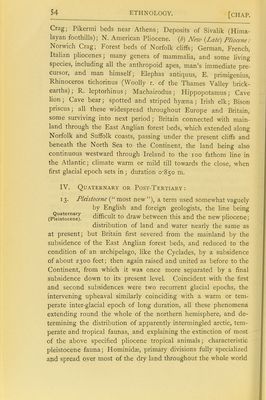
![Nothing can be definitely known; but it would seem that if the geologists ask too much, say, a round 100 m. (m = million) of years the physicists grant too little (20 m. or even less). Most, however, agree that the earlier stages took far more time in running their course than the later, the decrease of time proceeding by a sort of geometrical ratio down to the contemporary period. Hence if 50 be taken as a rough compromise between the extremes, the duration of the several epochs in the evolution of the earth's crust will be approximately as here indicated'. The point has an obvious bearing on the question of man's antiquity, as far as it can be measured in terms of years. The ratios of geological time are based on Prof. Ramsay's estimate, which assigns 79 per cent, to the palaeozoic system, 18 to the mesozoic, and 3 to the cainozoic, these being respectively about 57,000, 13,000, and 2,240 feet thick:— THE GEOLOGICAL SEQUENCE. L Primary or Arch^an : I. Laurentian and Huronian systems, largely developed in the Lower and Upper (Lake Huron) St Lawrence -^s^Ae. of Basin, whence their names ; over 30,000 (?) feet geological thick ; reddish gneiss : stratified crystalline rocks, sequence. . ^ . ^ ,. Archaean. mica schists, quartzites; unfossihferous hmestones ' Being mere ratios, the figures here given can of course adapt themselves to any view; those claiming 100 m. need but double them, while those satisfied with less can halve or quarter them to fancy, always, however, bearing in mind not only the slow growth, but also the subsequent weathering and disintegration of vast geological formations. In the Sahara alone some two million square miles of unstratified and sedimentary rocks have thus been triturated probably since secondary times. They were not deposited, as generally supposed, on a marine bed, and then upheaved. The sands of the Desert contain no marine fossils (Suess, Reclus, Playfair). ' Jottrn. Geological Soc. i860. No doubt these proportions have recently been questioned, and the extent of the palaeozoic system especially is believed to have been exaggerated. But until replaced by something definite, they may here be retained, all the more that the question of man's antiquity is not affected by the greater or less duration of the early geological eras. It may be added that .Mr John Perry seems now to have satisfied Lord Kelvin that his original 20 millions are far too little as the shortest limit: I should be exceedingly frightened to meet him [Geikie] now with only 20 millions in my mouth {Letter to Mr Perry, Nature, Jan. 3, 1895, p. 227). 4—2](https://iiif.wellcomecollection.org/image/b21500666_0087.jp2/full/800%2C/0/default.jpg)
 No text description is available for this image
 No text description is available for this image
 No text description is available for this image