Surgery illustrated. Compiled from the works of Cutler, Hind, Velpeau, and Blasius. With fifty-two plates / by A. Sidney Doane.
- Augustus Sidney Doane
- Date:
- 1836
Licence: Public Domain Mark
Credit: Surgery illustrated. Compiled from the works of Cutler, Hind, Velpeau, and Blasius. With fifty-two plates / by A. Sidney Doane. Source: Wellcome Collection.
27/312 page 17
![end, to within three fingers’ breadth of the centre, into three portions, the central being somewhat broader than the others. In applying it the snrgeon first reverses the posterior tails upon the central, and the anterior upon the posterior; placing the bandage upon the summit of the head, he takes the central tails, a a a, between the thumb and fingers of each hand, and passing them along the ears, secures them under- neath the chin, b, observing, however, to fold the edges of each tail inward so as to give it a triangular form, the base corresponding to the unsplit portion; the frontal tails are to be directed from the anterior to the posterior part of the head, where they should overlap each other; and the occipital tails at length brought forward and secured upon the brow. Its use is the same as the preceding, but it has the double advantage of not being liable to displacement, and of confining a larger dressing. The Capelma, [I. 18.] the bandage of Hippocrates, is formed by a double-headed roller. The centre of the roller is placed upon the occiput. After two or three circles the rollers intersect each other upon the forehead and occiput; one of these being then reflected over the vertex to the forehead, the other is continued in a circular course. They next cross each other upon the forehead, when the first head is carried obliquely backward to the occiput, and reflected by the side of the other. The last, a a, is continued in a circular direction, but the first, b, is again brought over the head, and carried in this way backward and forward in doloires till the head is entirely covered. This elegant bandage serves to confine dressings upon the head, but is rarely now employed; the ancients used it to compress the heads of hydrocephalic patients. The T Bandage of the Head [I. 19.] is formed by a band two yards long and two inches wide, upon which, at about 3](https://iiif.wellcomecollection.org/image/b29316509_0027.jp2/full/800%2C/0/default.jpg)
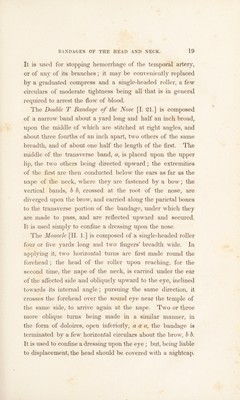
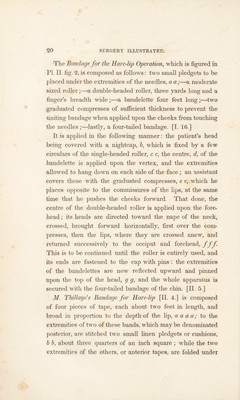
 No text description is available for this image
 No text description is available for this image
 No text description is available for this image