Report of the Departmental Committee on Humidity and Ventilation in Cotton Weaving Sheds : [with minutes of evidence and appendices].
- Great Britain. Home Office. Committee on Humidity and Ventilation in Cotton Weaving Sheds.
- Date:
- 1909
Licence: Public Domain Mark
Credit: Report of the Departmental Committee on Humidity and Ventilation in Cotton Weaving Sheds : [with minutes of evidence and appendices]. Source: Wellcome Collection.
10/296 (page 6)
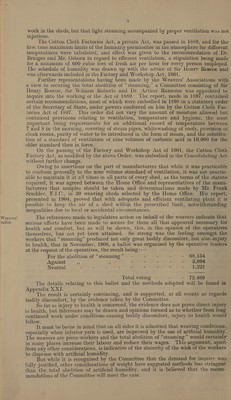
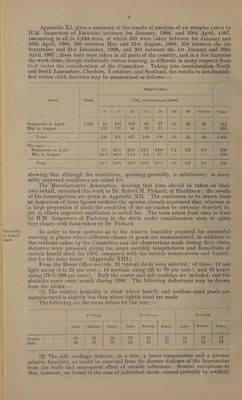
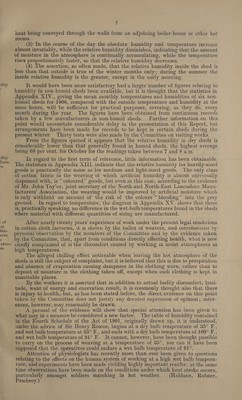
![| i Humidity in hamid 6 Appendix XI. gives a summary of the results of analysis of air samples taken by H.M. Inspectors of Factories between Ist January, 1906, and 30th April, 1907, amounting in all to 1,246 tests, of which 391 were taken between Ist. January and 30th April, 1906, 300 between May and 31st August, 1906, 254 between the Ist September and 3lst December, 1906, and 301 between the Ist January and 30th April, 1907; these tests were taken in all parts of the country, and in a few factories the work done, though technically cotton weaving, is different in many respects from that under the consideration of the Committee. Taking into consideration North and South Lancashire, Cheshire, Yorkshire, and Scotland, the results in non-humidi- fied cotton cloth factories may be summarised as follows :— Samples taken. Period. Sheds. (CO, in volumes per 10,000). tn a 6 9 | 12 15 20 25 | 30 Over 30 Total. September to April - 1,390 55 183 182 93 97 53 | 23 26 Le May to August- 108 118 ADS 16 pl — = -— 293 Meteo 50 158 | 301 | 227 |109 | 108 | 23 | 93. |. 26> | 1,005,) Per cent. :-— es} : September to April - 0 2S SB!) Boron aS Lie ARG 74 3°2 36% (1 IDO May to August’ - ‘ 35°] | 40°83. | 15:4 se Wi — —— —— 100 Total - LS77 30-0 P2266) LOS LO eae wee 23 2°6 100 showing that although the ventilation, speaking generally, is satisfactory, in many mills improved conditions are called for. | The Manufacturers’ Association, desiring that tests should be taken on their own behalf, entrusted this work to Dr. Robert H. Pickard, of Blackburn; the results of his investigations are given in Appendix XII. The conclusion to be drawn from. an inspection of these figures confirms the opinion already expressed that, whereas in. a large proportion of sheds the condition of the air cannot be seriously objected to, yet in others improved ventilation is called for. The tests taken from time to time by H.M. Inspectors of Factories in the sheds under consideration seem to agree: very closely with those taken by Dr. Pickard. In order to form opinions as to the relative humidity required for successful. weaving in places where different classes of goods are manufactured, in addition to the evidence taken by the Committee and the observations made during their visits, statistics were prepared giving the mean monthly temperatures and humidities of certain humid sheds for 1906, compared with the outside temperatures and humidi- ties for the same hours. (Appendix XIII.) ; From the Home Office reccrds, 31 typical sheds were selected. of these, 11 use light sizing (5 to 25 per cent.), 10 medium sizing (25 to 70 per cent.), and 10 heavy sizing (70 to 200 per cent.). Both the centre and side readings are included, and the: statistics cover every month during 1906. The following deductions may be drawn from the tables :— ? (1) The relative humidity in sheds where heavily and medium-sized goods are manufactured is slightly less than where lightly-sized are made. The following are the mean values for the year :— 6—7 a.m. 10—11 a.m. 3—-4 p.m. Light. | Medium. Heavy. Light. Medium. |’ Heavy. Light. Medium. | Heavy. Centre - 79 75 76 76 72 73 74 70 ih Side - - - 80 76 76 78 73 75 79 72 73 (2) The side readings indicate, as a rule, a lower temperature and a greater relative humidity, as would be expected from the shorter distance of the hygrometer from the walls and consequent effect of outside influences. Several exceptions to this, however, are found in the case of individual sheds, caused probably by artificial](https://iiif.wellcomecollection.org/image/b32172278_0010.jp2/full/800%2C/0/default.jpg)